Why Tracking Your Gym Workouts Gives You More Control Than a Personal Trainer

We hope you enjoy reading this blog post. Ready to upgrade your body? Click here
By Mofilo Team
Published
You're considering hiring a personal trainer because you feel stuck, but a part of you is skeptical if it's worth the $80 an hour. You want results, but more than that, you want to feel in control of your own fitness journey. The truth is, the key to that control isn't a person-it's a process.
Key Takeaways
- Tracking provides objective, undeniable data on your progress, while a trainer’s memory is subjective and can be inaccurate.
- By logging your workouts, you can apply the principle of progressive overload with 100% accuracy, which is the only way to guarantee strength gains.
- A good tracking app costs less than $10 a month, while a personal trainer can cost over $4,000 a year for two sessions a week.
- Tracking teaches you *why* you are getting stronger by showing you the relationship between weight, reps, and sets over time.
- Your workout data reveals patterns a trainer might miss, like how poor sleep on Tuesday affected your squat strength on Wednesday.
- Control comes from owning your data; you become the expert on your body, not dependent on someone else's opinion.
Why Relying Only on a Trainer Can Fail You
The reason why tracking your gym workouts gives you more control than a personal trainer is simple: data is objective, and a trainer's memory is not. You might be paying a premium for personalized attention, but you often end up with generalized advice and a frustrating lack of tangible proof that you're actually improving.
You feel like you're just going through the motions. The trainer tells you to do 3 sets of 10, you do them, and the hour is over. Next week, what happens? Maybe they remember what you lifted, maybe they don't. They're human. They manage 10, 20, or even 30 other clients. Your specific numbers from last Tuesday's session can easily get lost in the shuffle.
This leads to three major problems:
- The Subjectivity Trap: A trainer might say, "You look stronger today!" That feels good, but it isn't data. Did you lift more weight? Did you do more reps? Without a log, it's just a feeling. Tracking replaces feelings with facts. The log says you benched 135 lbs for 5 reps last week and 6 reps this week. That is real, undeniable progress.
- The Cookie-Cutter Plan: Many trainers, especially at commercial gyms, use recycled programs. You're paying for a personalized plan but getting the same workout as the person before you. When you track your own performance, your plan becomes 100% customized by default. The data *you* generate dictates what *you* do next. No one else has your exact strength levels or progression rate.
- The Cost-to-Value Gap: Let's do the math. A trainer at $80 per session, twice a week, costs $160 per week. That's $640 a month, or $7,680 a year. For that price, you expect flawless tracking and guaranteed results. But often, you get neither. A workout tracking app gives you perfect data and a clear path for progression for less than the cost of a single training session.
Without your own data, you are a passenger. With it, you are the pilot.

Stop guessing. Start growing.
Track your lifts in Mofilo. See your strength numbers go up every week.
No commitment · Cancel anytime
The Core Principles of Effective Workout Tracking
Tracking isn't just about writing down what you did. It's about collecting the right information so you can make intelligent decisions for your next workout. This entire process is built on one foundational concept: progressive overload.
Progressive overload is the principle of making your workouts slightly harder over time. Your muscles won't grow unless you give them a reason to. That reason is an increasing challenge. A trainer is supposed to manage this for you, but tracking allows you to do it yourself with surgical precision.
To do this effectively, you only need to track a few key metrics for each exercise:
- Exercise: The name of the movement (e.g., Barbell Bench Press).
- Weight: The amount of weight you lifted (e.g., 135 lbs).
- Reps: The number of repetitions you completed in a set (e.g., 8 reps).
- Sets: The total number of sets you performed (e.g., 3 sets).
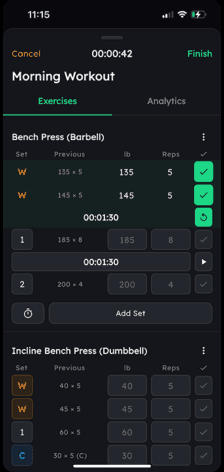
That's it. A simple entry might look like this:
`Barbell Squat`
- `Set 1: 185 lbs x 5 reps`
- `Set 2: 185 lbs x 5 reps`
- `Set 3: 185 lbs x 5 reps`
Some people also like to track their Rest Periods (e.g., 90 seconds) and Rate of Perceived Exertion (RPE), which is a 1-10 scale of how hard the set felt. An RPE of 10 means you couldn't have done another rep, while an RPE of 7 means you had 3 reps left in the tank.
Tracking these numbers turns the abstract goal of "getting stronger" into a simple, mathematical problem. Your goal for the next workout is no longer vague; it's to beat the numbers in your log. This is the essence of taking control.
Your progress, proven with data.
Every workout logged. Every personal record saved. Proof you are getting stronger.
No commitment · Cancel anytime
How to Start Tracking Your Workouts Today (A 3-Step Guide)
You don't need permission or a fancy certification to start. You can take control of your progress in your very next workout. Here’s how to do it in three simple steps.
Step 1: Choose Your Tool
You have two main options: a digital app or a physical notebook. A notebook is simple and requires no battery. You just write everything down. However, it's on you to do the math and spot the trends.
An app like Mofilo is built for this. It remembers your past performance for every exercise, shows you graphs of your progress, and automatically calculates your total workout volume (sets x reps x weight). This saves you the mental energy of flipping through old pages and lets you focus on lifting.
For 99% of people, an app is the superior choice because it automates the analysis.
Step 2: Record Your First Full Workout
During your workout, open your app or notebook before each exercise. Before your first working set, look at what you did last time. Let's say last week you did dumbbell shoulder presses with 40 lb dumbbells for 3 sets of 8, 7, and 6 reps.
Your goal today is to beat that. Maybe you aim for 8, 8, and 7 reps. After each set, immediately log the weight and reps you achieved. Be honest. If you only got 6 reps, write down 6. This data is for you, and accuracy is everything.
Record every single exercise, from your main compound lifts to your smaller isolation movements. It takes an extra 10-15 seconds per set, a tiny investment for the massive return in control and clarity.
Step 3: Use the Data to Plan Your Next Session
This is where the magic happens. At the end of your workout, you have a complete record. Before your next chest day, you'll look back at your log. You see you successfully hit your goal of 3 sets of 8 reps on the bench press at 155 lbs.
Now you have a clear mission for next time: increase the challenge. You have two primary options:
- Increase Weight: Move up to 160 lbs and aim for 3 sets of 5-6 reps.
- Increase Reps: Stick with 155 lbs and aim for 3 sets of 9 reps.
This is it. This simple decision-making process, based on your own performance data, is what separates a structured training plan from just "working out." You are now in complete control, using objective feedback to drive progress. You've become your own coach.
What to Expect When You Start Tracking
Switching from aimlessly working out to meticulously tracking is a significant change, and the benefits unfold in stages. Here is a realistic timeline of what you'll experience.
Weeks 1-2: The Adjustment Period
The first few sessions will feel a bit clunky. You'll be focused on remembering to log each set. It might feel like it's slowing you down, but stick with it. The goal here isn't to see massive progress yet; it's to build the habit of data collection. Just get the numbers down accurately.
Weeks 3-4: The "Aha!" Moment
This is when you'll experience the first real payoff. You'll look back at your log from Week 1 and see undeniable proof of progress. The weight on your deadlift has gone up 15 pounds. You're doing two more reps on every set of pull-ups. This objective validation is a powerful motivator, far more potent than a trainer's empty encouragement. You'll realize the system works.
Month 3+: Total Autonomy
By now, tracking is second nature. You'll walk into the gym with a clear, data-driven mission for every exercise. You'll not only see your progress but understand *why* it's happening. If you hit a plateau, you won't panic. You'll look at your data, identify the problem (maybe your volume has stalled or you need a deload), and make a calculated adjustment.
You are no longer guessing. You are not dependent on anyone. You have a system, you have the data, and you have complete control over your results.
Frequently Asked Questions
What if I hit a plateau even while tracking?
Tracking makes plateaus easier to solve. If your numbers stop improving, it's a signal to change a variable. You can try increasing your training volume (adding a set), decreasing your rest times, or switching to a different exercise variation for a few weeks.
Do I need to track cardio workouts too?
It's less critical than tracking strength training, but it can be very useful. Tracking your time, distance, and pace on a run, for example, allows you to apply progressive overload to your cardiovascular fitness. You can aim to run the same 3 miles 30 seconds faster next time.
When is a personal trainer actually a good idea?
A good trainer is invaluable for a complete beginner learning foundational movements like the squat, deadlift, and bench press. Paying for 3-5 sessions to master form and safety is a fantastic investment. After that, you can use tracking to manage your own progress.
How detailed should my notes be?
At a minimum, track the exercise, weight, reps, and sets. Adding notes on how a set felt (RPE) or why you failed a rep can be very helpful. For example: "Failed 5th rep, grip gave out." This tells you that your back was strong enough, but your grip is a weak point to work on.
Can tracking replace a good program?
No. Tracking is the method you use to execute a program. A good program provides the structure (which exercises to do, how many days a week), and tracking is the tool you use to ensure you're progressing within that structure. Your log data helps you know when to move forward in the program.
Conclusion
A personal trainer can offer guidance, but they cannot give you ownership. True control comes from understanding your own performance through objective data. Tracking your workouts transforms you from a passive follower into the active architect of your own strength.
All content and media on Mofilo is created and published for informational purposes only. It is not intended to be a substitute for professional medical advice, diagnosis, or treatment. Always seek the advice of your physician or other qualified health provider with any questions you may have regarding a medical condition, including but not limited to eating disorders, nutritional deficiencies, injuries, or any other health concerns. If you think you may have a medical emergency or are experiencing symptoms of any health condition, call your doctor or emergency services immediately.