Why Looking at Fitness Data Is Demotivating

We hope you enjoy reading this blog post. Ready to upgrade your body? Try Mofilo Free
By Mofilo Team
Published
You bought the fitness watch, downloaded the tracking app, and started logging every calorie and every lift. You were told this was the key to staying motivated. But instead of feeling empowered, you feel defeated. This guide explains the real reason why looking at fitness data is demotivating and gives you a simple framework to fix it.
Key Takeaways
- Daily weight fluctuations of 2-5 pounds are normal due to water, salt, and carbs; they are not fat gain.
- The reason data feels demotivating is you're confusing daily “noise” with the long-term “signal” of your progress.
- To see real trends, compare your bodyweight average from one week to the next, not one day to the next.
- True strength progress is measured over a 4-week period, not by whether you lifted 5 pounds more in a single workout.
- A single “bad” data point, like a slower run or a weaker lift, is meaningless for your overall journey.
- The only three metrics you need to track are your weekly weight average, monthly lift performance, and progress photos.
Why Your Fitness Data Is Lying to You
The reason why looking at fitness data is demotivating is that you're mistaking daily 'noise' for a long-term 'signal' of failure. You see one number go the wrong way-the scale is up 1.5 pounds-and your brain screams that the entire week was a waste. This is the single biggest mistake people make. Your body is not a simple machine where input equals predictable output every 24 hours.
Think of it like this: 'Signal' is the real, underlying trend. 'Noise' is the random, meaningless daily fluctuation that hides the signal.
Signal: Your average weight dropped by 0.8 pounds from last week to this week.
Noise: You weighed 1.5 pounds more on Wednesday than you did on Tuesday.
Most people get so obsessed with the noise that they can't even see the signal. They have a great week, but one weird weigh-in on Friday morning convinces them to give up.
Here’s what’s actually causing that daily noise:
- Water and Carbs: For every 1 gram of carbohydrate your body stores, it also holds onto 3-4 grams of water. If you ate a pasta dinner last night, your weight will be up this morning. This is water, not fat. It will be gone in a day or two.
- Sodium: A salty meal can cause you to retain water, easily adding 1-3 pounds of temporary weight overnight.
- Stress & Sleep: A bad night's sleep raises cortisol, a stress hormone that causes water retention. You can be in a perfect calorie deficit and still see the scale go up simply because you were stressed or slept poorly.
- Workout Soreness: A tough leg day causes micro-tears in your muscles. Your body sends water and blood to repair them, causing inflammation and a temporary weight increase.
When you stare at a single day's data, you are not seeing your progress. You are seeing a snapshot of your hydration status and last night's dinner. It's useless information that only serves to derail you.

Stop letting bad data kill your motivation.
See your real progress. Know you are on the right track.
No commitment · Cancel anytime
The 3 Data Traps That Crush Motivation
You're not just misinterpreting the data; you're likely falling into one of three common traps that are practically designed to make you feel like quitting. Identifying them is the first step to breaking free.
Trap 1: Worshipping the Daily Scale Reading
This is the most common and destructive trap. You wake up, use the bathroom, and step on the scale. That number dictates your mood for the entire day. If it's down, you're a champion. If it's up, you're a failure who might as well eat a pint of ice cream because what's the point?
Look at this realistic example of a week's weigh-ins for someone successfully losing fat:
- Monday: 180.2 lbs
- Tuesday: 181.1 lbs (Panic!)
- Wednesday: 179.8 lbs (Relief!)
- Thursday: 180.5 lbs (Frustration!)
- Friday: 179.5 lbs
If you live and die by the daily number, you would have felt like a failure on Tuesday and Thursday. But the trend is clearly downward. The weekly average is what matters, not the daily rollercoaster.
Trap 2: Chasing Perfect, Linear Progress
Fitness progress is never a straight line. You will not add 5 pounds to your bench press every week. You will not lose exactly 1 pound every 7 days. It doesn't work that way.
Progress looks like a jagged, messy line that is trending in the right direction over time. Some weeks you'll feel strong and hit personal records. The next week, you might be tired from work, sleep poorly, and struggle to lift what you did the week before. This is normal.
Expecting every workout to be better than the last is a recipe for disappointment. The goal is for your performance over a month to be better than the previous month. One bad workout is just a single data point. It means nothing.
Trap 3: Drowning in Too Many Metrics
Your watch tracks your sleep score, your Heart Rate Variability (HRV), your steps, your resting heart rate, and your estimated calorie burn. Your app tracks 30 different exercises. Your scale tracks body fat percentage, water mass, and bone density.
It's too much. This is analysis paralysis. When you track 20 different things, you will always find one metric that is “bad.” Your HRV is down, your sleep score is 72 instead of 80, or your estimated calorie burn was lower than yesterday. This one negative data point can overshadow the 19 positive ones, leaving you feeling discouraged.
Most of these metrics are also wildly inaccurate. A fitness watch's calorie burn estimate can be off by 20-93%. A smart scale's body fat reading is an imprecise guess. You're making emotional decisions based on faulty, irrelevant data.
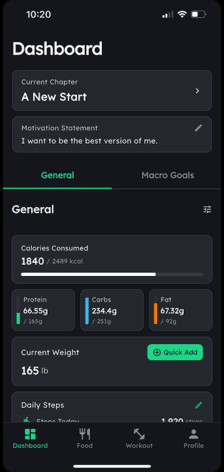
Your real progress. All in one place.
Track what matters. See the trends that prove you're winning.
No commitment · Cancel anytime
The Mofilo Framework: How to Track Progress That Motivates
Stop letting data control you. It's time to use it as the tool it's meant to be. This framework simplifies everything, focusing only on the 'signal' and ignoring the 'noise.'
Step 1: Track the Right Things (The Signal)
Forget the dozens of metrics. You only need to focus on three things. Everything else is a distraction.
- Metric 1: Weekly Bodyweight Average. Weigh yourself every morning under the same conditions (after using the bathroom, before eating/drinking). Log the number and forget it. At the end of the week, calculate the average. Your only goal is to see that this week's average is slightly lower than last week's average. That's it. That's the win.
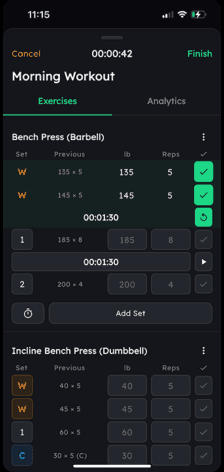
- Metric 2: Monthly Lift Performance. For your 2-4 main compound exercises (like squats, deadlifts, bench press, overhead press), track your performance. The goal isn't to add weight every session. The goal is to see improvement over a 4-week block. This could be adding 5 pounds to the bar, doing one more rep with the same weight, or simply having the weight feel easier. Compare Week 1 of this month to Week 1 of last month.
- Metric 3: Progress Photos. The scale doesn't tell the whole story. Take photos every 4 weeks-front, side, and back. Use the same lighting, same time of day, and same pose. When the scale stalls but your photos show more definition, you'll know you're building muscle and losing fat. This is often the most motivating metric of all.
Step 2: Set the Right Timeframes
Your frustration comes from using the wrong timeframes. You're looking at a daily snapshot when you should be looking at a feature film.
- Weight: Compare weekly averages. Never compare one day to the next.
- Strength: Compare monthly performance. Never judge your entire progress on one bad workout.
- Photos: Compare every 4-8 weeks. You won't see changes day-to-day.
Step 3: Define Your 'Win' Before You Look
Change your mindset by setting a realistic goal before you even look at the data. This puts you in control.
- Before weighing in: Don't hope for a magic number. Instead, tell yourself, "My only goal is to log this number so I can calculate my weekly average. This single number does not define my progress."
- Before a workout: Don't expect to break a world record. Instead, define the win as, "My goal is to complete all my sets and reps with good form. Hitting my plan is the victory."
This simple reframing shifts the focus from an uncontrollable outcome (the number on the scale) to a controllable action (executing your plan).
What to Do When the Data Looks 'Bad'
Even with the right framework, you'll have days where the data feels discouraging. Here’s the emergency plan.
If the scale is up unexpectedly: Do not react. Take a breath and run through the checklist. Did I eat more salt or carbs yesterday? Did I sleep poorly? Am I sore from a workout? The answer is almost always yes. Remind yourself it's just water weight. Trust the weekly average, not the daily spike. The worst thing you can do is slash your calories or do extra cardio out of panic.
If your lift felt weak: It's just one day. Nobody is 100% every day. Maybe you're tired, stressed, or didn't eat enough. It does not mean you're getting weaker. It means you're human. The next workout will be better. A single workout is a drop in the ocean of your total training volume over a year.
If you feel totally overwhelmed: Take a "data detox." For one full week, stop tracking everything. Don't weigh yourself. Don't log your workout. Don't count calories. Just focus on executing your plan: eat healthy foods, show up to the gym, and get your sleep. You will quickly realize that the tracking is a helpful tool, but it is not the process itself. This reset can do wonders for your mental health and remind you why you started in the first place.
Frequently Asked Questions
How often should I weigh myself?
You should weigh yourself daily to get the most accurate weekly average. Weighing in only once a week is risky; you might catch yourself on a high-fluctuation day and think you've made no progress when you actually have.
What if my weight loss stalls for a week?
A one-week stall is not a plateau. It's often just noise from water retention masking underlying fat loss. If your weekly average is the same for 2-3 consecutive weeks while you're sticking to your plan, then it's time to make a small adjustment, like reducing calories by 100-200.
Is it better to track calories or just eat clean?
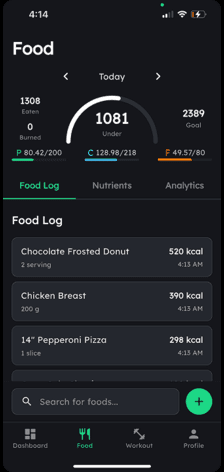
Tracking calories is far more effective. "Clean" foods can still be very high in calories (think nuts, avocados, olive oil). You can easily overeat healthy food and prevent fat loss. Tracking provides certainty and removes the guesswork.
My fitness watch says I burned 800 calories. Is that accurate?
No, it is not. Calorie burn estimates from watches are notoriously inaccurate and should be completely ignored. They can be off by hundreds of calories. Use your watch to track steps or time, but never use its calorie burn estimate to make decisions about your diet.
Should I stop tracking data completely?
If it's causing you severe stress, taking a break is a great idea. But for long-term results, tracking is an invaluable tool. The key isn't to stop tracking, but to start tracking the right things with the right perspective, as outlined in this guide.
Conclusion
Fitness data is a tool, not a report card. Stop letting daily noise distract you from the long-term signal of your progress.
Focus on the trend, trust the process, and get back to work.
All content and media on Mofilo is created and published for informational purposes only. It is not intended to be a substitute for professional medical advice, diagnosis, or treatment. Always seek the advice of your physician or other qualified health provider with any questions you may have regarding a medical condition, including but not limited to eating disorders, nutritional deficiencies, injuries, or any other health concerns. If you think you may have a medical emergency or are experiencing symptoms of any health condition, call your doctor or emergency services immediately.