Why Am I Not Making Progress Even With a Workout Plan

We hope you enjoy reading this blog post. Ready to upgrade your body? Try Mofilo Free
By Mofilo Team
Published
It's one of the most frustrating feelings in fitness. You have a plan. You show up to the gym 3, 4, even 5 times a week. You do the exercises. You sweat. But when you look in the mirror or at the weights you're lifting, nothing has changed in a month. You're stuck. This guide will explain exactly why you're not making progress and give you the precise, no-BS system to fix it.
Key Takeaways
- The answer to 'why am I not making progress even with a workout plan' is almost always a lack of tracked progressive overload, not a bad plan.
- If you are not adding weight, reps, or sets over time, your body has no reason to change. Progress is not accidental.
- Your nutrition determines the outcome of your training. You cannot build muscle without a 200-300 calorie surplus or lose fat without a 300-500 calorie deficit.
- "Program hopping" every few weeks is a primary cause of failure. You must stick to one plan for at least 8-12 weeks to see meaningful results.
- Progress is not a feeling. You must track your lifts, bodyweight, and calories to have objective proof that you are moving forward.
Why Your Workout Plan Isn't the Problem
The most common question I get from people who are stuck is, "What's the best workout plan?" They assume their routine is the issue. The answer to 'why am I not making progress even with a workout plan' is almost never the plan itself. It's the execution. You can have the most scientifically perfect program in the world, but if you perform it the same way week after week, you will plateau. It's a guarantee.
Think of it like this: a workout plan is just a map. The map shows you the roads, but it doesn't drive the car. Driving the car is applying progressive overload-the principle of doing more over time. Your muscles are adaptive. The first time you lift a weight, it's a shock. Your body responds by getting a little stronger to handle that stress better next time. But if "next time" is always the same weight for the same reps, your body quickly thinks, "Okay, I've adapted to this. No need to change further."
This adaptation happens fast, usually within 4-6 weeks. After that, showing up and going through the motions is just maintenance. You aren't giving your body a new reason to build muscle or get stronger. You feel like you're working hard, but you're just spinning your wheels. The work feels difficult, but the stimulus for growth is gone.

Your workout plan is not enough.
Track your lifts. See your strength grow week by week.
No commitment · Cancel anytime
The Real Reason You're Stuck: The Plateau Trifecta
If your plan isn't the problem, what is? It comes down to three common, fixable mistakes. Chances are, you're making at least one of them right now. These are the silent progress killers that keep people stuck for months or even years.
1. You're Not Tracking Progressive Overload
Progressive overload is the single most important principle for getting stronger and building muscle. It simply means making your workouts harder over time. If you are not tracking, you are not truly progressing. You are guessing.
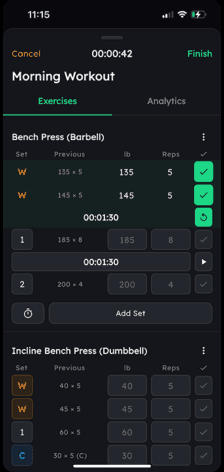
"Going by feel" does not work. You might feel tired, but that doesn't mean you lifted more than last week. Your memory is unreliable. You must write it down. Here’s what that looks like:
- Week 1: Barbell Squat - 135 lbs for 3 sets of 8 reps.
- Week 2: Barbell Squat - 135 lbs for 3 sets of 9 reps. (You added one rep).
- Week 3: Barbell Squat - 140 lbs for 3 sets of 8 reps. (You added 5 lbs).
This is measurable progress. Without a logbook or an app tracking this, you are flying blind. You will inevitably repeat the same workouts and wonder why you're not getting stronger.
2. Your Nutrition Is Undermining Your Workouts
Fitness results are 80% nutrition and 20% training. You cannot ignore this. A perfect workout plan will fail 100% of the time if your diet is not aligned with your goal.
If your goal is to build muscle: You must be in a calorie surplus. You cannot build a house without bricks. Your body needs extra energy (calories) and materials (protein) to construct new muscle tissue. Aim for a modest surplus of 200-300 calories above your maintenance level. Without it, you're just asking your body to perform a miracle.
If your goal is to lose fat: You must be in a calorie deficit. You cannot empty a bucket that has a running hose in it. Your body will only burn stored fat for energy if it's getting less energy from food than it needs. Aim for a deficit of 300-500 calories below maintenance. No amount of crunches or cardio will reveal your abs if a layer of fat is covering them, and that layer only goes away with a sustained deficit.
3. You're "Program Hopping" Too Soon
When progress feels slow after 2 or 3 weeks, it's tempting to blame the program and search for a new one. This is a massive mistake. Real, physiological changes take time. You need to give a program at least 8-12 weeks of consistent, tracked effort before you can judge it.
Every time you switch your routine, you reset your progress. You introduce new movements your body isn't used to, which creates soreness and the illusion of a "good workout." But you never spend enough time on one set of exercises to actually get good at them and apply progressive overload. You're always a beginner, stuck in week one of a new plan.
Weeks of progress. All in one place.
Every workout logged. Proof you're getting stronger.
No commitment · Cancel anytime
The 4-Step System to Break Your Plateau Today
Enough theory. Here is the exact, actionable system to get you unstuck. Start this today. Not next week, not next month. Today.
Step 1: Choose ONE Primary Goal
For the next 12 weeks, you can either focus on building muscle or losing fat. You cannot do both effectively at the same time unless you are a brand-new lifter. Trying to do both just leads to spinning your wheels. Pick one.
- Goal A: Build Muscle. You will focus on getting stronger and accept that you might gain a little body fat in the process.
- Goal B: Lose Fat. You will focus on a calorie deficit and accept that your strength gains will be slow or non-existent.
Commit to one goal. This decision dictates everything else.
Step 2: Calculate Your Target Calories and Protein
This is non-negotiable. You need to stop guessing what you're eating. Use these simple formulas to get your starting numbers:
- Find Maintenance Calories: Your Bodyweight (in lbs) x 15. (This is an estimate, but it's a great starting point).
- Set Your Goal Calories:
- For Muscle Gain: Maintenance Calories + 300.
- For Fat Loss: Maintenance Calories - 500.
- Set Your Protein Target: Your Bodyweight (in lbs) x 0.8 grams.
Example for a 180 lb person:
- Maintenance: 180 x 15 = 2700 calories.
- Muscle Gain Target: 2700 + 300 = 3000 calories.
- Fat Loss Target: 2700 - 500 = 2200 calories.
- Protein Target: 180 x 0.8 = 144 grams per day.
Step 3: Implement a Tracking System
This is the step that changes everything. Starting with your very next workout, you will track three key metrics:
- Your Lifts: Use a notebook, a phone note, or an app. For every exercise, log the weight, sets, and reps you performed. Before you start your next set, look at what you did last week. Your goal is to beat it.
- Your Bodyweight: Weigh yourself every morning after using the bathroom and before eating or drinking anything. Log it. At the end of the week, calculate the average. This weekly average is your true weight. A single day's weight is meaningless.
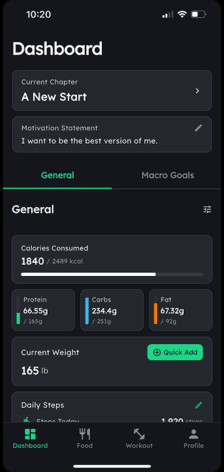
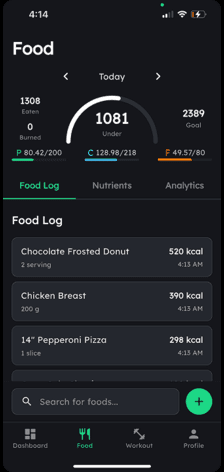
- Your Calories: Use a food tracking app for at least two weeks. You need to learn what 2,500 calories and 150 grams of protein actually look like. This educational period is crucial. You don't have to track forever, but you must do it long enough to stop guessing.
Step 4: Apply the "Plus One" Rule
This makes progressive overload simple. For your main compound lifts (like squats, bench press, deadlifts, overhead press), your goal each week is to add "plus one" of something.
- Add one more rep to each set than you did last week.
- Add 2.5 or 5 lbs to the bar.
- Add one more set to the exercise.
That's it. This tiny, consistent effort is what forces your body to adapt. It's not about adding 20 pounds to your bench press in a week. It's about adding 1 rep. Then another. Then 5 pounds. Over 12 weeks, these small wins compound into massive progress.
What Real Progress Looks and Feels Like (A Realistic Timeline)
Progress in the gym is slow. Social media has warped our expectations. Here is a realistic timeline so you don't get discouraged and quit three weeks before your breakthrough.
Weeks 1-2: The Adaptation Phase. You'll feel sore. The movements might feel awkward. Your bodyweight will fluctuate wildly as it adapts to the new routine and potential changes in diet (especially carb and sodium intake). Your strength won't jump up yet. Trust the process and focus on executing the plan and tracking your numbers. This phase is about building the habit.
Weeks 3-8: The Momentum Phase. This is where the magic starts. Your technique on the lifts will feel solid. You'll see consistent, small wins in your logbook-an extra rep here, 5 more pounds there. If you're cutting fat, your weekly average bodyweight will show a clear downward trend of 0.5-1.5 pounds per week. If you're bulking, it will show a clear upward trend of 0.25-0.5 pounds per week. You are now making measurable progress.
Weeks 9-12: The Visible Change Phase. This is when you, and maybe others, will start to see a physical difference. Your clothes might fit better. You'll notice more shape or definition in the mirror. This is the payoff for the first 8 weeks of consistent, boring, tracked work. Most people quit before they ever get here.
Progress is not a straight line. You will have bad days and weak workouts. That's normal. But your data logbook will show you the truth: over the course of months, the trend is moving up and to the right. That's all that matters.
Frequently Asked Questions
How do I know if my workout plan is actually bad?
A plan is likely bad if it's all isolation exercises (like curls and leg extensions) and no compound lifts (squats, deadlifts, bench press). It's also bad if it has extreme volume (like 25-30 sets per workout) or doesn't have a clear way to progress. But honestly, 90% of plans are fine; the problem is the lack of tracking and progression.
How much weight should I increase each week?
For big lower-body lifts like squats and deadlifts, aim to add 5-10 pounds (2.5-5 kg) per week for as long as you can. For upper-body lifts like bench press and overhead press, aim for 2.5-5 pounds (1-2.5 kg). The smallest possible jump is the best jump because it allows for longer progression.
What if I get stuck and can't add weight or reps?
If you stall on a lift for 2-3 consecutive weeks while your nutrition and sleep are on point, it's time for a deload. For one week, reduce the weight you're lifting by 20% and cut your sets in half. This gives your body time to recover, and you'll often come back stronger.
Do I have to track calories forever?
No. The goal of tracking is education. Track your food intake strictly for 2-4 weeks. This teaches you about portion sizes and the calorie/protein content of the foods you eat. After that, you can use that knowledge to eat more intuitively while still hitting your goals.
How important is sleep for making progress?
Sleep is the most underrated factor in fitness. It is when your body repairs muscle tissue and solidifies hormonal processes for growth. Getting less than 7 hours of quality sleep per night will severely hinder your recovery and sabotage your progress. If you're stalled, fixing your sleep is often more effective than changing your workout.
Conclusion
A workout plan is not a magic document. It is a map. Your progress is determined by how you navigate that map-by consistently taking one more step, lifting one more pound, and tracking your journey. Stop blaming your plan and start taking ownership of your progression.
Your journey out of this plateau begins with your next workout. Log your lifts, aim to beat your last session by a single rep, and you will be on the path to the progress you've been working for.
All content and media on Mofilo is created and published for informational purposes only. It is not intended to be a substitute for professional medical advice, diagnosis, or treatment. Always seek the advice of your physician or other qualified health provider with any questions you may have regarding a medical condition, including but not limited to eating disorders, nutritional deficiencies, injuries, or any other health concerns. If you think you may have a medical emergency or are experiencing symptoms of any health condition, call your doctor or emergency services immediately.