What Are the Biggest Strength Training Myths for People Over 50

We hope you enjoy reading this blog post. Ready to upgrade your body? Try Mofilo Free
By Mofilo Team
Published
It's not too late, and you are not too old. The conversation around strength training for people over 50 is filled with fear and bad advice. This guide cuts through the noise to give you the truth.
Key Takeaways
- You can absolutely build muscle after 50; expect to gain 5-10 pounds of lean mass in your first year with proper training and nutrition.
- Lifting “heavy” is crucial for bone density and is safer than being weak; “heavy” is a weight that challenges you for 5-10 reps.
- Persistent soreness is not a sign of a good workout; the real measure of progress is consistently lifting more weight or doing more reps over time.
- Proper strength training strengthens the muscles around your joints, reducing pain and improving stability, not wearing them down.
- You do not need to live in the gym; 2-3 full-body workouts of 45-60 minutes per week is the most effective schedule for building strength and recovery.
Myth #1: It’s Too Dangerous and You’ll Get Hurt
Let's get this out of the way, because it's the core of what are the biggest strength training myths for people over 50. You've been told to be careful, to take it easy, that lifting weights will wreck your joints and lead to injury. The opposite is true. Being weak is far more dangerous.
Every year, millions of adults over 50 suffer from falls that lead to serious injury. The primary cause is a lack of strength and stability. Strength training directly combats this. It improves your balance, strengthens your bones, and builds the muscle you need to catch yourself from a fall or get up from the floor. Done correctly, it reduces your risk of serious injury from daily life by over 40%.
The danger isn't in the dumbbell; it's in the ego. Injuries happen when people lift too much weight, too soon, with bad form. The solution isn't to avoid lifting; it's to be smart about it.
Start with a weight that feels almost too light. Focus entirely on mastering the movement. For a squat, this might mean just using your bodyweight. For a press, it might be a 5-pound dumbbell. Your goal in the first month isn't to lift heavy; it's to build the pattern perfectly. Only then do you begin to add weight, slowly and methodically, maybe 2.5-5 pounds at a time. This approach makes strength training one of the safest activities you can do.

Stop feeling weak. Start getting strong.
Track your lifts in Mofilo. See your strength grow week by week, no guessing.
No commitment · Cancel anytime
Myth #2: You Can't Build Muscle After 50
This is simply false. While the rate of muscle growth might be slightly slower than for a 20-year-old, the ability to build muscle, known as hypertrophy, never goes away.
As we age, we experience sarcopenia, which is the natural loss of muscle mass and function. From age 50 onwards, you can lose up to 1-2% of your muscle mass per year if you are inactive. Strength training is the single most effective way to stop and even reverse this process.
A 60-year-old man or woman starting a proper strength training program can expect to gain 5-10 pounds of new muscle in their first year. This is transformative. That's 5-10 pounds of metabolically active tissue that helps regulate blood sugar, increases your metabolism, and makes every physical task easier.
The two non-negotiable requirements are the same at any age:
- Progressive Overload: You must continually challenge your muscles by lifting slightly more weight or doing more reps over time.
- Adequate Protein: You cannot build a house without bricks. Aim for 0.7 grams of protein per pound of body weight daily (or 1.6g per kg). For a 170-pound person, that's about 120 grams of protein per day.
Your body wants to adapt. If you give it the right stimulus (lifting) and the right building blocks (protein), it will build muscle, regardless of the date on your birth certificate.
Myth #3: You Should Only Lift Light Weights for High Reps
This myth is born from the fear described in Myth #1. The advice to use 3-pound pink dumbbells for 20 reps is common in “senior fitness” and it is completely ineffective for building real strength or bone density.
Your muscles and bones adapt to the stress placed upon them. To trigger a change, the stress must be significant enough to signal the body that it needs to get stronger. Lifting a weight you could move 30 or 40 times does not send that signal. It improves muscular endurance, which is fine, but it does not build meaningful strength or increase bone mineral density.
“Lifting heavy” does not mean you need to lift like a 25-year-old powerlifter. It means lifting a weight that is heavy *for you*. The sweet spot for building strength and muscle is a weight you can lift with perfect form for 5-10 repetitions. The last 1-2 reps should be challenging, but not impossible.
How to Find Your “Heavy”
Let’s use a Goblet Squat as an example:
Step 1: Pick a Light Weight
Grab a 15-pound dumbbell. Hold it vertically against your chest. Your feet should be shoulder-width apart, toes pointed slightly out.
Step 2: Perform 8 Reps with Perfect Form
Sit back and down as if you're aiming for a chair behind you. Keep your chest up and your back straight. Go as low as you can comfortably without pain, then drive back up to the starting position.
Step 3: Assess the Difficulty
After 8 reps, how did it feel on a scale of 1 to 10, where 10 is maximum effort? If it was a 5/10 (you could have done 10 more reps), the weight is too light.
Step 4: Adjust and Repeat
Rest for 2 minutes. Pick a 20-pound dumbbell and repeat. Did that feel like a 7 or 8 out of 10? If so, you've found your starting weight. If it still felt too easy, you can go up to 25 pounds in your next session. This is your effective working weight.
Your progress. Proof you're not 'too old'.
Every workout is logged. See exactly how much stronger you are than last month.
No commitment · Cancel anytime
Myth #4: You Need to Feel Sore for it to Work
Many people, especially those new to training, believe that muscle soreness the day after a workout is the badge of a productive session. If they aren't wincing when they get out of a chair, they think they didn't work hard enough. This is a destructive mindset.
Delayed Onset Muscle Soreness (DOMS) is simply a response to a new or unusually intense stimulus. It's most pronounced when you first start training or dramatically change your routine. It is not an indicator of muscle growth.
Your goal should not be to chase soreness. Chasing soreness leads to taking too many days off, performing subsequent workouts with poor form because you're stiff, and an increased risk of injury. The real sign of a successful program is not pain, but progress.
Are you getting stronger? That's the only question that matters. The proof is in your training log, not in your level of discomfort.
Here’s how to track progress correctly:
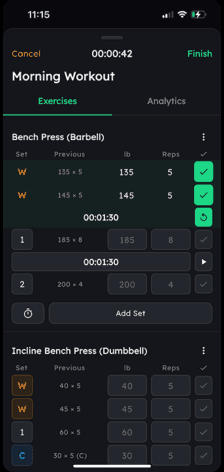
- Last week: You goblet squatted 25 pounds for 3 sets of 8 reps.
- This week: You goblet squat 25 pounds for 3 sets of 9 reps.
That is progress. That is the signal that your body is adapting and getting stronger. The following week, you might aim for 10 reps. Once you can do 3 sets of 10, you increase the weight to 30 pounds and start back at 8 reps. This is progressive overload in action. It has nothing to do with how sore you feel.
Expect some mild stiffness when you begin, but this should fade within a few weeks as your body adapts. A productive workout should leave you feeling energized and capable, not broken.
Frequently Asked Questions
What exercises are best for someone over 50?
The best exercises are compound movements that use multiple muscle groups at once. Focus on variations of the squat, hinge, push, and pull. Examples include Goblet Squats, Romanian Deadlifts with dumbbells, Incline Push-ups (with hands on a bench), and Seated Cable Rows. These deliver the most benefit for your time.
How much protein do I need to eat?
Aim for 0.7 grams of protein per pound of your body weight (or 1.6 grams per kilogram). For a 180-pound person, this is about 126 grams per day. Spread this out over 3-4 meals, aiming for 30-40 grams per meal to maximize muscle protein synthesis.
Is creatine safe for people over 50?
Yes. Creatine is one of the most researched supplements on the planet and is extremely safe and effective for older adults. It not only improves strength and muscle retention but also has proven benefits for bone health and cognitive function. Take 5 grams of creatine monohydrate daily.
How often should I work out?
For strength training, 2 to 3 full-body sessions per week is the sweet spot. This schedule provides enough stimulus for growth while allowing 48 to 72 hours between workouts for your muscles and nervous system to recover, which is essential for progress.
What about my bad knees/back?
Unless a doctor has told you to avoid specific movements, strength training is the solution, not the problem. By strengthening the muscles that support your joints (quads, hamstrings, glutes, core), you reduce pain and instability. Start with bodyweight exercises and focus on a pain-free range of motion. For example, Box Squats are excellent for teaching the squat pattern without stressing the knees.
Conclusion
It is not too late. You are not too fragile. The biggest risk you face is not the risk of getting injured in the gym, but the guaranteed physical decline that comes from doing nothing. Start smart, be consistent, and focus on getting stronger every week.
All content and media on Mofilo is created and published for informational purposes only. It is not intended to be a substitute for professional medical advice, diagnosis, or treatment. Always seek the advice of your physician or other qualified health provider with any questions you may have regarding a medical condition, including but not limited to eating disorders, nutritional deficiencies, injuries, or any other health concerns. If you think you may have a medical emergency or are experiencing symptoms of any health condition, call your doctor or emergency services immediately.