Weighted Dips vs Close Grip Bench

We hope you enjoy reading this blog post. Ready to upgrade your body? Click here
By Mofilo Team
Published
The debate over weighted dips vs close grip bench has filled gym floors and internet forums for years. You see one person with massive triceps who swears by dips, and a powerlifter who only uses close grip bench. The truth is, one isn't universally 'better'-they are different tools for different jobs. For pure triceps size with a focus on the stretch, weighted dips have a slight edge. For building raw pressing strength that carries over to other lifts, the close grip bench press is superior and generally safer.
Key Takeaways
- For pure triceps mass, weighted dips are slightly better due to a greater stretch and range of motion, assuming you have healthy shoulders.
- For building foundational pressing strength and safer, more measurable progression, the close grip bench press is the winner.
- Weighted dips primarily target the long head of the triceps and lower chest, while close grip bench focuses more on the lateral and medial heads.
- Your grip on a close grip bench should be shoulder-width, not with hands touching, to protect your wrists and effectively target the triceps.
- You must be able to perform at least 15-20 perfect bodyweight dips before you even consider adding weight to the exercise.
- Programming both exercises on different days-one for strength (CGBP) and one for hypertrophy (dips)-is the optimal strategy for advanced lifters.
What's the Real Difference in Muscle and Strength?
When you're trying to decide between weighted dips vs close grip bench, you're really asking which tool will build your triceps and chest faster. Let's break down the mechanics so you can stop guessing.
The close grip bench press is a horizontal pressing movement. You lie on a stable surface, which provides support for your back and shoulders. This stability is key. It allows you to focus all your energy on pushing the weight and makes it much easier to progressively overload in small, manageable jumps. You can add 2.5 or 5 pounds to the bar each week. This is the gold standard for measurable strength gains.
Weighted dips, on the other hand, are a vertical pressing movement. Your body is suspended in the air, which forces your stabilizer muscles in your shoulders, chest, and core to work much harder. This instability is both a pro and a con. It builds functional strength, but it also puts your shoulder joint in a more vulnerable position.
Here’s the main difference: range of motion. A proper dip takes your shoulder through a much deeper range of motion than a bench press. This creates an incredible stretch on the triceps and lower chest fibers, which is a powerful stimulus for hypertrophy (muscle growth). The eccentric (lowering) phase of a dip is where most of the muscle-building magic happens.
However, that same deep stretch is what makes it riskier. If you go too deep-letting your shoulders roll forward at the bottom-you put immense stress on the shoulder capsule and rotator cuff. The close grip bench press limits this range, making it the safer default option, especially for those with a history of shoulder pain.
Muscle Activation Breakdown:
- Weighted Dips: Emphasize the long head of the triceps (the biggest part) and the sternal (lower) head of the pectoralis major.
- Close Grip Bench: Emphasizes the lateral and medial heads of the triceps and the clavicular (upper) head of the pectoralis major, along with the anterior deltoids.

Build bigger, stronger triceps.
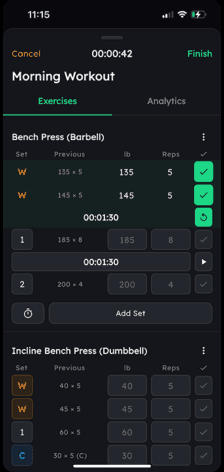
Track your lifts. See your strength grow week by week.
No commitment · Cancel anytime
Why One Exercise Might Be Holding You Back
You're putting in the work, but your triceps aren't growing, or your shoulders are starting to ache. It's a common frustration, and the cause is often a mismatch between the exercise you've chosen and your current abilities or form.
If you feel shoulder pain during or after dips, you are almost certainly doing one of two things wrong: going too deep or letting your elbows flare out. The advice to get a "deep stretch" is dangerous. You should only lower yourself until your upper arms are parallel to the floor, or your shoulders are slightly below your elbows. Going past this point provides no extra benefit and dramatically increases injury risk.
If you don't feel your triceps working during a close grip bench press, your grip is probably wrong. Many people place their hands just inches apart. This doesn't hit your triceps better; it just puts your wrists and elbows in a terrible position. Your grip should be shoulder-width apart. This allows your elbows to stay tucked and makes the triceps the prime mover, not your joints.
Another common issue is getting stuck at the same weight. With weighted dips, progression can be awkward. Going from a 25-pound plate to a 35-pound plate is a 40% jump in weight, which is often too much. It's hard to make small, consistent increases.
The close grip bench solves this. You can add 5 pounds to the bar (a 2.5-pound plate on each side) and keep progressing week after week. This predictable, linear progression is why it's a staple for building raw strength.
This is for you if: You have healthy shoulders and your primary goal is maximizing triceps size.
This is not for you if: You have a history of shoulder impingement or pain, or if you cannot yet do 15 clean bodyweight reps.
How to Program For Your Specific Goal
Stop thinking about which exercise is "best" and start thinking about which is best for *your* goal right now. Here’s a simple framework.
Goal 1: Maximum Triceps Mass
The Winner: Weighted Dips
Why: The deep stretch and eccentric overload are unmatched for hypertrophy. If your shoulders can handle it, this is the fastest path to bigger triceps.
How to Program: Perform this exercise after your main compound press (like a flat bench or overhead press). Aim for 3-4 sets of 8-12 reps. Focus on a slow, controlled 3-second negative on every rep. Once you can hit 12 reps with perfect form, add 5-10 pounds.
Goal 2: Pure Pressing Strength & Safer Growth
The Winner: Close Grip Bench Press
Why: It’s more stable, safer on the shoulders, and infinitely easier to progressively overload. The strength you build here has a direct carryover to your flat bench press.
How to Program: Use this as your primary or secondary pressing movement. Aim for 3-4 sets in the 5-8 rep range. This is a strength movement, so focus on adding 5 pounds to the bar as often as you can while maintaining perfect form.
Goal 3: The Best of Both Worlds (Advanced)
The Method: Use both exercises in your weekly rotation.
Why: This allows you to get the unique benefits of each movement. You can build raw strength with the close grip bench and then chase the hypertrophy stimulus with dips.
How to Program: Structure your push days around different goals.
- Push Day A (Strength Focus):
- Flat Barbell Bench Press: 3 sets of 5 reps
- Close Grip Bench Press: 3 sets of 6-8 reps
- Lateral Raises: 3 sets of 12-15 reps
- Push Day B (Hypertrophy Focus):
- Incline Dumbbell Press: 3 sets of 8-12 reps
- Weighted Dips: 3 sets of 8-12 reps (or bodyweight to failure)
- Cable Pushdowns: 3 sets of 10-15 reps
This approach ensures you're building both strength and size without over-stressing your joints with the same movement pattern twice a week.
Weeks of progress. All in one place.
Every workout logged. Proof you're getting stronger.
No commitment · Cancel anytime
Common Mistakes That Are Killing Your Gains
Perfect form isn't about looking good; it's about getting results and staying injury-free. Here are the most common mistakes people make with both exercises.
Weighted Dip Mistakes
- Going Too Deep: This is the #1 cause of shoulder pain from dips. People drop until their shoulders scream, thinking a deeper stretch means more growth. It doesn't. It just wrecks your shoulder capsule.
- The Fix: Stop when your upper arms are parallel to the floor. Your shoulder should be roughly in line with your elbow. Film yourself from the side to check your depth.
- Flaring Your Elbows: When your elbows flare out to the sides, the stress shifts from your triceps and chest directly onto your shoulder joint.
- The Fix: Keep your elbows tucked in at about a 45-degree angle to your torso. Think about screwing your hands into the bars.
- Leaning Too Far Forward: A slight forward lean is fine and hits more chest. But if you're trying to target triceps, you want to stay as upright as possible.
- The Fix: Keep your chest up and your torso vertical throughout the movement. This places the emphasis squarely on the triceps.
Close Grip Bench Press Mistakes
- Using a 'Too Close' Grip: Bringing your hands together until your index fingers are touching is a classic mistake. It offers no extra triceps activation and puts your wrists and elbows at high risk.
- The Fix: Place your hands directly over your shoulders. For most people, this means your index fingers will be on the edge of the smooth part of the barbell. This is the strongest and safest position.
- Bouncing the Bar Off Your Chest: Using momentum to get the weight up removes the stimulus from the muscle and teaches a bad motor pattern.
- The Fix: Lower the bar under control (a 2-second negative), pause for a split second on your chest, and then explode up. This ensures the muscle is doing all the work.
- Letting Your Elbows Flare: Just like with dips, flaring your elbows to 90 degrees on a bench press is a recipe for shoulder impingement.
- The Fix: Tuck your elbows to a 45-60 degree angle relative to your torso. Think about 'bending the bar' in your hands to engage your lats and keep your shoulders safe.
Frequently Asked Questions
Which is better for chest growth?
For overall chest mass, neither is a primary builder like a standard flat or incline press. However, weighted dips with a slight forward lean are excellent for developing the lower chest, while close grip bench can help fill out the inner and upper chest.
Which is safer for shoulders?
The close grip bench press is significantly safer for most people. The stable, supported position and limited range of motion protect the shoulder joint. Dips, when performed with perfect form, are safe, but the risk of error and injury is much higher.
Can I do weighted dips and close grip bench on the same day?
You can, but it's often redundant. Both are demanding compound pressing movements. A better approach is to pick one as your main triceps accessory for the day or to use them on separate push days, as outlined in the 'Best of Both Worlds' section.
How much weight should I use for weighted dips?
Start with zero weight. Do not add any weight until you can comfortably perform 3 sets of 15-20 bodyweight dips with perfect form. Once you can, start by adding just 10-25 pounds using a dip belt and progress slowly from there.
What if I can't do a single dip?
Use an assisted dip machine, which uses a counterweight to make you 'lighter'. If your gym doesn't have one, use a resistance band looped over the handles and placed under your knees. You can also focus on negative dips, jumping to the top position and lowering yourself as slowly as possible for 5-8 seconds.
Conclusion
Stop the endless debate. The choice between weighted dips and close grip bench press depends entirely on your goal, your body, and your experience level. Use the close grip bench for your foundation of safe, measurable strength, and use weighted dips as a tool to maximize hypertrophy once your foundation is solid. Now pick one, perfect your form, and get to work.
All content and media on Mofilo is created and published for informational purposes only. It is not intended to be a substitute for professional medical advice, diagnosis, or treatment. Always seek the advice of your physician or other qualified health provider with any questions you may have regarding a medical condition, including but not limited to eating disorders, nutritional deficiencies, injuries, or any other health concerns. If you think you may have a medical emergency or are experiencing symptoms of any health condition, call your doctor or emergency services immediately.