Should I Log My Reps If I Don't Hit My Target

We hope you enjoy reading this blog post. Ready to upgrade your body? Try Mofilo Free
By Mofilo Team
Published
You're in the middle of a workout, pushing hard on a set of bench presses. The program says '3 sets of 10 reps'. You get to 7... 8... you push with everything you have for number 9, but the bar isn't moving. You re-rack the weight, breathing heavily. Now you're staring at your workout log or app, and the real question hits: what do you write down?
Key Takeaways
- Always log the exact number of reps you completed with good form, not the target number you were aiming for.
- A 'missed' rep target is not a failure; it is the most important data you can collect to make your next workout better.
- If you miss your rep target by 3 or more reps on your first set, the weight is too heavy for that day.
- Use the '2-Rep Rule' for progressive overload: if you can do 2 more reps than your target, increase the weight by 5-10 lbs next week.
- For a complete picture, log three things for every set: the weight, the reps you actually did, and the RPE (Rate of Perceived Exertion) on a 1-10 scale.
Why Logging Your 'Failures' Is Actually a Success
The answer to 'should I log my reps if I don't hit my target' is simple: Yes, absolutely. In fact, logging that you only got 8 reps when you aimed for 10 is the most valuable data you can collect. That single piece of information is more important than all the 'perfect' sets where you hit your target easily.
Think of your workout log as a data sheet for a science experiment, and your body is the subject. The goal is to collect honest, accurate data, not to write a story about how strong you wish you were. Logging the target number (10) when you only did 8 is lying to your data sheet. It's driven by ego, not by a desire for progress.
Progress in the gym is never a straight line pointing up. Some days you'll walk in feeling strong after 8 hours of sleep and a good meal. Other days, you'll be tired from work, stressed, and a little dehydrated. Your log should reflect this reality. An accurate log tells the true story of your strength on any given day.
When you log the 'failure'-the missed rep-you are creating a data point. This data point tells you something critical: the weight you used for the reps you completed is at or near your current limit. This is not a moral failing. It is the information you need to make an intelligent decision about your next set and your next workout. A log full of 'missed' targets is infinitely more useful than a log full of lies.

Stop guessing. Start getting stronger.
Track your lifts with Mofilo. Know exactly when to add weight and see your strength grow.
No commitment · Cancel anytime
The Common Logging Mistakes That Stall Your Progress
Most people who track their workouts still make mistakes that sabotage their own progress. They collect data but have no idea how to use it, or worse, they collect bad data. Here are the most common errors we see.
Mistake 1: Logging the Target, Not the Reality
This is the cardinal sin of workout logging. Your plan says 10 reps, you do 8, but you write down 10 to 'complete' the workout. This is pure ego. The consequence is that next week, you'll try to increase the weight based on a false accomplishment. This leads directly to hitting a plateau, getting frustrated, or even getting injured.
Mistake 2: Only Logging 'Good' Days
Some people get discouraged on a 'bad' day and just don't log their workout at all. They think, 'I was weak today, so it doesn't count.' This creates a biased and useless record. Your log needs to show the full picture, including the days you felt weak. Those data points help you see patterns related to sleep, stress, or nutrition.
Mistake 3: Counting 'Cheat Reps'
You're doing bicep curls and your target is 12 reps. Reps 10, 11, and 12 involve you swinging your back and using momentum to heave the weight up. You write down '12 reps'. You didn't do 12 reps. You did 9 good reps and 3 sloppy ones. Only reps completed with consistent, good form count. Logging cheat reps is the same as logging a number you didn't hit.
Mistake 4: Not Having a System for the Data
Just writing down '135 lbs x 8 reps' is better than nothing, but it's incomplete. What do you do with that information? Do you increase the weight? Do you do more reps? Without a clear set of rules, your log is just a diary. It's not a tool for progress. You need a system that tells you what action to take based on your performance.
Your progress. Proven with data.
Every workout logged. Every rep counted. See the proof that you're getting stronger week by week.
No commitment · Cancel anytime
The 3-Part System for Perfect Logging
To make your log a powerful tool for progress, you need to track more than just a single number. You need a simple system that captures the full context of each set. Here is the 3-part system that works every time.
Step 1: Log What You Actually Did (The Reps & Weight)
This is the foundation. It's non-negotiable. If the target is 10 reps and you get 8, you write down 8. If you get 11, you write down 11. Be brutally honest. The number you write down is the number of full, clean reps you completed. No half-reps, no cheat reps.
Your log entry starts like this:
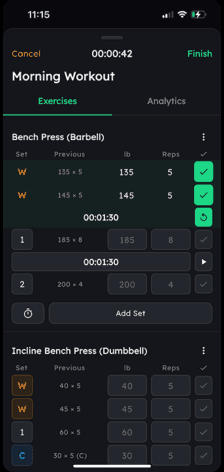
- Bench Press: 135 lbs x 8 reps
Step 2: Add Context with RPE (The Effort)
This is what separates beginners from intermediates. RPE stands for Rate of Perceived Exertion. It's a simple scale from 1 to 10 that measures how hard the set felt.
- RPE 10: Absolute failure. You could not have done another rep no matter what.
- RPE 9: You had one more rep left in the tank, but that's it.
- RPE 8: You had two more reps left in the tank. This is the sweet spot for most training sets.
- RPE 7: You had three more reps left. The weight felt moderately easy.
Now, your log entry looks like this:
- Bench Press: 135 lbs x 8 reps @ RPE 9
This tells a much richer story. It says you did 8 reps, and it was very challenging-you only had one rep left before failure. This is a fantastic data point.
Step 3: Use the Data to Make a Decision (The Action)
Now you use that data to decide what to do next. Here are the rules:
- The 'Increase the Weight' Rule: If you hit the TOP of your rep range (e.g., 12 reps in an 8-12 range) and your RPE is 8 or lower, it's time to increase the weight. Add 5 lbs for upper body lifts or 10 lbs for lower body lifts in your next workout.
- The 'Stay Put' Rule: If you are within your rep range (e.g., 9 reps in an 8-12 range), keep the weight the same for your next workout. Your goal is to beat your previous rep count. So next time, you'll aim for 10 reps with that same weight.
- The 'Regress to Progress' Rule: If you miss the BOTTOM of your rep range by 2 or more reps (e.g., you got 6 reps when the target was 8-12), the weight is too heavy. For your next set or workout, reduce the weight by 10% and focus on hitting the rep target with good form.
What to Expect When You Start Logging Accurately
Adopting this system will feel different, but it will transform your training. Here is a realistic timeline of what you can expect.
In the First Week:
It will feel strange and maybe even a little discouraging. Your ego will want you to write down the target number. Writing '6 reps @ RPE 10' feels like admitting defeat. It's not. It's you becoming a smarter lifter. Stick with it. The goal this week is 100% honesty in your log.
In the First Month:
You'll start seeing clear patterns. You'll notice that you are consistently stronger on Tuesdays than on Fridays. You'll see that your squat performance drops if you don't eat enough carbs beforehand. The RPE scale will become second nature. You'll stop seeing 'missed reps' as failure and start seeing them as valuable signals.
After Two Months:
This is where the magic happens. You now have a data-rich logbook that tells the story of your progress. You can look back and see exactly how you got from benching 135 lbs for 8 reps to 155 lbs for 8 reps. You make decisions in the gym based on your own data, not on guesswork or how you feel that day. Your progress will become more consistent and predictable because you have replaced hope with a system. You are no longer just exercising; you are training.
Frequently Asked Questions
What if my form breaks down on the last rep?
A rep only counts if it's completed with good form through the full range of motion. If you have to contort your body or shorten the range to complete it, that rep does not count. Log the number of good reps you did before your form broke down.
Should I lower the weight to hit my rep target?
If you miss your target by 3 or more reps on the first set, the weight is too heavy. It is better to lower the weight by 5-10% and complete the remaining sets in your target rep range with good form. If you only miss by 1-2 reps, keep the weight and try to beat it on the next set.
What's more important: hitting the rep target or increasing the weight?
Hitting your rep target with good form is the prerequisite. You earn the right to increase the weight by consistently performing at the top end of your designated rep range. Focus on owning the reps first, then on adding weight.
How often should I fail to hit my reps?
You should aim to train close to failure (RPE 8-9) on your main work sets. This means you will 'fail' to hit another rep regularly. However, if you are failing to hit the minimum reps for your first set (e.g., getting 4 reps in an 8-12 range), your starting weight is too heavy.
Is a digital app better than a notebook?
The best tracking tool is the one you will use consistently for every single workout. A digital app like Mofilo can automate the progressive overload rules and chart your progress for you. A simple notebook works perfectly if you are disciplined enough to apply the rules yourself.
Conclusion
Stop thinking of missed reps as failures. Start seeing them as data. Logging what you actually do-not what you wish you did-is the fastest way to unlock consistent, long-term strength gains. This is the difference between just going to the gym and truly training for results.
All content and media on Mofilo is created and published for informational purposes only. It is not intended to be a substitute for professional medical advice, diagnosis, or treatment. Always seek the advice of your physician or other qualified health provider with any questions you may have regarding a medical condition, including but not limited to eating disorders, nutritional deficiencies, injuries, or any other health concerns. If you think you may have a medical emergency or are experiencing symptoms of any health condition, call your doctor or emergency services immediately.