Is Junk Volume for Biceps Killing My Gains

We hope you enjoy reading this blog post. Ready to upgrade your body? Click here
By Mofilo Team
Published
You're doing curls at the end of every workout, hitting them with 20, maybe even 30 sets a week. You're putting in the work, but your arms aren't growing. It’s frustrating, and it makes you feel like you're wasting your time. You're not alone in this-it's one of the most common plateaus in the gym.
Key Takeaways
- Junk volume is any set performed past the point of effective stimulus, where fatigue outweighs the muscle-building signal.
- For biceps, the optimal range is 10-14 direct, hard sets per week; anything over 20 sets is almost certainly junk volume that hinders recovery.
- The three main signs of junk volume are a loss of pump during your workout, a sharp drop in performance from set to set, and persistent soreness without strength gains.
- Effective sets are those taken 1-2 reps shy of true muscular failure, where you can feel a strong mind-muscle connection.
- Replace junk volume by focusing on 2-3 high-quality bicep exercises for 3-4 sets each, twice a week, and prioritize adding weight or reps over adding more sets.
What Is Junk Volume, Really?
If you're asking, 'is junk volume for biceps killing my gains?', the answer is almost certainly yes, especially if you're doing more than 14 hard sets per week. Junk volume is any training set that adds more fatigue than it does muscle-building stimulus. It's the work you do after you've already triggered growth, and at that point, you're just digging a deeper recovery hole for no reason.
Think of it like watering a plant. The first bit of water is essential for growth. Once the soil is saturated, any extra water you pour just runs off or, worse, drowns the roots. Those extra sets of curls you're doing after your biceps are already exhausted are that extra water. They feel productive, but they're only making it harder for your muscles to recover and grow back stronger.
The key concept here is the Stimulus-to-Fatigue Ratio (SFR). Every set you do has both a stimulus component (the signal for your muscles to grow) and a fatigue component (the stress on your muscles, joints, and nervous system).
- Effective Sets: High stimulus, low fatigue. These are the first few hard sets where you feel a great connection and can move good weight.
- Junk Volume Sets: Low stimulus, high fatigue. These are the sloppy, half-rep sets at the end of a long workout when you're just going through the motions.
For a small muscle group like the biceps, the growth signal is maximized relatively quickly. The first 3-5 hard sets in a single workout provide around 80% of the possible growth stimulus. Adding another 2-3 sets might eke out a tiny bit more, but anything beyond 6-8 sets in one session is almost entirely fatigue. You get no more growth, just more damage to recover from.

Stop guessing. Start growing.
Track your bicep curls. See your strength go up every week.
No commitment · Cancel anytime
Why 'More Curls' Is a Trap
You've probably seen someone on social media with huge arms talking about their 30-set arm day. So you tried it. You added more exercises, more drop sets, more everything. And yet, your arms look the same. This 'more is better' mindset is a trap that keeps so many people from making progress.
Your body has a finite capacity to recover, known as your Maximum Recoverable Volume (MRV). Once you exceed your MRV for a muscle group, you don't grow more; you actually regress. You're breaking down muscle tissue faster than your body can repair it.
Here are the three clear signs that you're deep in junk volume territory and need to pull back immediately.
Sign 1: You Lose the Pump
During your first few sets of curls, you get a great pump. Your biceps feel full and tight. This is a good sign that blood is shuttling into the muscle. However, if by your fifth or sixth exercise you feel 'flat' and can't seem to get that pump back no matter how hard you try, you're done. The muscle is too fatigued to respond. Chasing a pump that's already gone is a classic example of junk volume.
Sign 2: Your Performance Drops Off a Cliff
Let's say you start your workout with dumbbell curls, hitting 30 lbs for 10 clean reps. On your second set, you get 9 reps. On your third, maybe 8. This is normal fatigue. But if on your fourth set, you can barely get 6 reps with 20 lbs, your bicep function has collapsed. Any further sets are just teaching your body to be weak. Effective training involves maintaining a high level of performance across your sets. A massive drop-off is your body's emergency brake.
Sign 3: You're Constantly Sore But Not Getting Stronger
There's a difference between the satisfying muscle soreness (DOMS) that fades in a day or two and the persistent, nagging ache that never goes away. If your biceps are still sore when it's time to train them again, you haven't recovered. And if you haven't recovered, you can't get stronger. Progress is measured by adding weight or reps to the bar, not by how sore you can make yourself. If your logbook shows your curl numbers have been stuck for a month but you're always sore, you're doing too much.
Your bicep progress. All in one place.
Every set and rep logged. Proof you are getting stronger.
No commitment · Cancel anytime
How to Replace Junk Volume With Effective Volume (The 3-Step Fix)
The solution isn't to stop training biceps. It's to be smarter about it. The goal is to find the sweet spot of 'just enough' volume to trigger growth and then get out of the gym so you can recover. Here’s how to do it.
Step 1: Calculate Your Weekly Set Target
Stop thinking about sets per workout and start thinking about sets per week. For natural lifters, the optimal range for bicep growth is between 10-14 direct, hard sets per week. If you're doing more than 20, you are absolutely doing junk volume.
Start at the low end: 10 sets per week. Distribute them across two sessions to maximize recovery and growth signals.
- Example Schedule:
- Monday (Pull Day): 5 sets for biceps
- Thursday (Pull Day): 5 sets for biceps
A 'hard set' means you take it to about 1-2 Reps in Reserve (RIR). In other words, you stop the set when you know you only have 1-2 perfect reps left in the tank. This provides all the stimulus of going to failure without the massive fatigue.
Step 2: Choose High-Quality Exercises
You don't need seven different types of curls. You need 2-3 good ones that you can progressively overload. Pick one exercise that challenges the bicep in the shortened position, one in the mid-range, and one in the stretched position.
- Shortened Position: Preacher Curl, Spider Curl
- Mid-Range: Barbell Curl, Dumbbell Curl
- Stretched Position: Incline Dumbbell Curl, Bayesian Cable Curl
- Sample Workout (10 Sets Total):
- Monday: Barbell Curls (3 sets of 8-10) + Incline Dumbbell Curls (2 sets of 10-12)
- Thursday: Preacher Curls (3 sets of 10-12) + Hammer Curls (2 sets of 8-10)
This is more than enough volume to stimulate growth if your intensity is high.
Step 3: Track Your Lifts and Progressively Overload
This is the most important step. Instead of adding more sets when you want to progress, you must add weight or reps to your existing sets. This is progressive overload, and it is the number one driver of muscle growth.
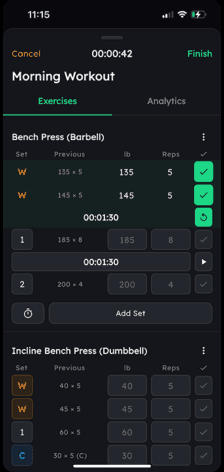
Keep a logbook. Write down every set, every rep, and every weight.
- Week 1: Dumbbell Curls - 30 lbs for 10, 9, 8 reps.
- Week 2: Your goal is to beat that. Aim for 30 lbs for 10, 10, 9 reps.
- Week 3: You hit 30 lbs for 12, 11, 10 reps. Now you've earned the right to go up in weight.
- Week 4: Move up to 35 lbs and aim for 8 reps.
This relentless focus on getting stronger within your 10-14 weekly sets is what builds muscle, not adding a 15th, 16th, and 17th set of sloppy curls.
What to Expect When You Cut the Junk
Switching from high-volume, low-quality training to low-volume, high-quality training can feel strange at first. You need to trust the process.
Week 1-2: Your workouts will feel shorter, and you might leave the gym feeling like you could have done more. This is a good thing. It means you have gas left in the tank for recovery. You'll notice you feel fresher, and the constant bicep soreness will disappear.
Week 3-4: This is when the magic starts. Because you're fully recovered for each session, you'll see your strength numbers start to climb consistently. The weights you use for your curls will go up, or you'll be hitting more reps. This is the proof that the system is working.
Week 8-12: You should see and feel a noticeable difference. Your arms will look fuller, and you'll have the logbook data to prove you're significantly stronger than you were two months ago. You built that strength and size with less work, not more.
Only after you've stalled for 2-3 consecutive weeks-meaning you cannot add a single rep or pound to your lifts-should you consider adding more volume. And when you do, add it slowly. Go from 10 weekly sets to 12, not from 10 to 20. Let your performance guide you.
Frequently Asked Questions
How many sets for biceps is too much in one workout?
For most people, anything over 6-8 hard sets for biceps in a single session provides diminishing returns. After this point, you're accumulating fatigue much faster than you're stimulating new growth. Stick to 4-6 high-quality sets per workout, twice a week.
Do pull-ups and rows count towards bicep volume?
Yes, they contribute as indirect volume. While they primarily target the back, your biceps work hard as secondary movers. A good rule of thumb is to count every 2-3 sets of heavy pulling (like rows or chin-ups) as roughly one direct set for your biceps.
Should I train biceps to failure?
Training 1-2 reps shy of failure (Reps in Reserve 1-2) provides nearly all the muscle-building stimulus with far less systemic fatigue. Going to absolute failure constantly makes recovery much harder. It's best to save all-out failure for the very last set of an exercise, and even then, only occasionally.
How often should I train biceps per week?
Training biceps twice per week is the sweet spot for most lifters. This frequency allows you to stimulate the muscle, give it 48-72 hours to recover and grow, and then hit it again. Training them only once a week often isn't enough stimulus, and training them 3+ times a week can lead to recovery issues.
Does junk volume apply to other muscles like chest or legs?
Yes, the principle is universal for all muscle groups. Larger and more complex muscles like the back and legs can handle more weekly volume (e.g., 16-22 sets) before hitting junk territory, but the limit still exists. Smaller muscles like biceps, triceps, and delts have a much lower threshold.
Conclusion
Muscle growth is not a reward for suffering; it's a response to a precise and recoverable stimulus. Stop chasing fatigue with endless sets and start chasing progress with intelligent, high-quality work.
Cut your bicep volume in half, focus on getting brutally strong within that 10-14 set range, and you will finally see the growth you've been working for.
All content and media on Mofilo is created and published for informational purposes only. It is not intended to be a substitute for professional medical advice, diagnosis, or treatment. Always seek the advice of your physician or other qualified health provider with any questions you may have regarding a medical condition, including but not limited to eating disorders, nutritional deficiencies, injuries, or any other health concerns. If you think you may have a medical emergency or are experiencing symptoms of any health condition, call your doctor or emergency services immediately.