Is It Worth Doing Bicep Curls at Home With Light Dumbbells

We hope you enjoy reading this blog post. Ready to upgrade your body? Try Mofilo Free
By Mofilo Team
Published
You're staring at that pair of 10 or 15-pound dumbbells in the corner of your room, wondering if they're just glorified paperweights. The question of is it worth doing bicep curls at home with light dumbbells is really a question of frustration. You've probably done countless reps, felt a temporary "burn," but weeks later, your arms look exactly the same. The good news is the problem isn't the light weight; it's how you're using it.
Key Takeaways
- Yes, light dumbbell curls build muscle if you train within 1-3 reps of muscular failure.
- The effective rep range for light weights is higher, typically 15-30 reps per set.
- You must apply progressive overload by increasing reps, sets, or slowing your tempo-not just adding weight.
- Train biceps 2-3 times per week, allowing at least 48 hours of rest for muscles to recover and grow.
- If you can do more than 30-35 reps easily, you must use advanced techniques like tempo changes or partial reps to create a stimulus.
- Muscle growth requires adequate protein; aim for 0.8-1.0 grams per pound of your body weight daily.
Why Your Light Dumbbell Curls Aren't Working
Let's be honest. You've tried it. You picked up your 15-pound dumbbells, did 3 sets of 10-12 reps, and felt a nice little pump. You did this three times a week for a month. And nothing happened. This is the most common frustration, and it's the reason most people believe light weights are useless for building muscle.
You feel like you're putting in the effort, but you're not seeing the reward. Your arms don't look fuller, your t-shirt sleeves don't feel any tighter, and you're starting to think you need a full gym membership with racks of heavy weights.
The problem isn't your effort; it's your method. Your muscles are incredibly efficient at adapting. After a week or two of curling 15 pounds for 12 reps, your body says, "I've got this. This is easy." The stimulus is no longer strong enough to signal a need for growth. Those 12 reps become "junk volume"-effort that doesn't produce a result.
Real muscle growth is triggered by pushing your muscles close to their limit. It’s about the *quality* of the reps, not just the quantity. The last 2-3 reps of a set-the ones that are a genuine struggle-are the only ones that tell your body it needs to get stronger and bigger. If your sets of 10-12 reps aren't a struggle, you're just warming up.

Stop wasting reps. Start building muscle.
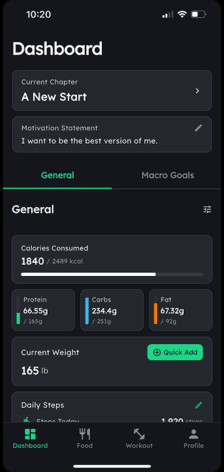
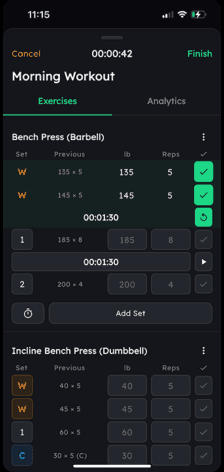
Track your reps and sets. See the proof you are actually getting stronger.
No commitment · Cancel anytime
The Science of Muscle Growth with Light Weight
Muscle growth, or hypertrophy, is primarily driven by one thing: mechanical tension. This is the force your muscle experiences when it contracts against resistance. For decades, the prevailing wisdom was that the only way to create enough tension was to lift heavy weights in the 6-12 rep range.
But that's only half the story. Another pathway to muscle growth is metabolic stress. This is the "burn" you feel from the buildup of metabolic byproducts like lactate in the muscle. When you use lighter weights for higher reps (e.g., 15-30 reps), you can create immense metabolic stress.
The key is that the set must be taken close to muscular failure. Muscular failure is the point where you cannot complete another repetition with proper form. The reps you perform just before hitting that point are called "effective reps."
Whether you reach failure on rep #8 with a 40-pound dumbbell or rep #25 with a 15-pound dumbbell, the signal for growth is surprisingly similar. Your muscle fibers don't have calculators; they just know they were pushed to their absolute limit and were forced to recruit every available fiber to move the weight. That struggle is the trigger.
So, the myth that you *must* lift heavy to grow is false. You must create a significant challenge. Heavy weight is just the most straightforward tool to create that challenge. With light weights, you just have to use a different strategy-higher reps and a relentless focus on reaching near-failure.
The 4-Step Method to Make Light Dumbbells Effective
This is where we turn theory into action. Forget your old 3x10 routine. Here is the exact four-step process to force your biceps to grow using the light dumbbells you already own.
Step 1: Find Your True Failure Point
First, you need a baseline. Pick up one of your dumbbells and perform as many bicep curls as you possibly can with good form. Don't swing your back. Control the weight. Count every single rep until you physically cannot lift the dumbbell for one more curl. Let's say you hit 28 reps. That number, 28, is your current max.
This isn't just an exercise; it's data. It tells you the absolute upper limit of what your muscle can do with that weight right now. Now you have a target to work with.
Step 2: Work in the High-Rep Hypertrophy Range
Your new goal is to perform 3-4 working sets in the 15-30 rep range. The key is that each set should end 1-2 reps *before* you hit your failure point. Using our example of a 28-rep max, your first set might be 26 reps. After a 60-90 second rest, your next set might be 22 reps. Your third set might be 19 reps. All of these sets are effective because the last few reps were a serious struggle.
If you can easily do more than 30-35 reps, your weight is likely too light to be efficient, and you'll need to rely more heavily on the techniques in Step 4.
Step 3: Apply Progressive Overload Without Adding Weight
This is the most critical step. To keep growing, you must continually challenge your muscles more over time. Since you can't add weight, you'll manipulate other variables:
- Add Reps: This is the simplest form. If you did 26, 22, 19 reps this week, your goal next week is to beat it. Aim for 27, 23, 20. Even one extra rep is progress.
- Add Sets: Once you can comfortably perform 3 sets of 25+ reps, add a fourth set. This increases your total workout volume.
- Decrease Rest: If you normally rest 90 seconds between sets, cut it to 75 seconds. Then 60. This forces your muscles to work harder with less recovery, increasing metabolic stress.
- Slow Down the Tempo: This is a game-changer. Instead of just lifting the weight up and down, control it. Use a 3-1-1 tempo: take three full seconds to lower the weight (the eccentric phase), pause for one second at the bottom, and take one second to lift it. This dramatically increases the time your muscle is under tension, making a 15-pound weight feel like 30.
Step 4: Use Advanced Techniques When You Plateau
Eventually, you'll get so strong that you can do 40+ reps even with slow tempo. At this point, you need to introduce new techniques to increase the intensity.
- Myo-Reps: Perform one main set to failure (e.g., 30 reps). Rest for only 15 seconds (about 5 deep breaths), then perform another mini-set to failure (which might only be 5-8 reps). Repeat this 2-4 more times. This is a highly efficient way to accumulate effective reps.
- Partial Reps: After you hit failure on a normal set, immediately perform 5-10 half-reps or quarter-reps in the most challenging part of the movement. This pushes the muscle beyond its normal failure point.
- Isometric Holds: On the final rep of your set, hold the dumbbell at a 90-degree angle (the halfway point) for as long as you can. Squeeze the bicep as hard as possible until you're forced to drop the weight.
Your progress. All in one place.
Every workout logged. Watch your arms get bigger and stronger week by week.
No commitment · Cancel anytime
What to Expect: A Realistic Timeline
Applying these techniques will work, but it's not magic. It's biology, and it takes time. Here is an honest timeline of what you should expect when you start training this way.
Weeks 1-2: You will feel a significant increase in muscle soreness, known as Delayed Onset Muscle Soreness (DOMS). This is a good sign. It means you've introduced a new, powerful stimulus that your body isn't used to. The pump you get during your workouts will feel more intense and last longer.
Weeks 3-4: The initial extreme soreness will fade as your body adapts. You should see clear progress in your logbook. Your rep counts will be going up, or you'll be using a slower tempo with the same number of reps. The exercises will feel more natural, and your mind-muscle connection with your biceps will improve.
Weeks 4-8: This is when you might start to see the first visible changes. Your arms may look slightly fuller, especially the day after a workout. You might notice more definition or a better bicep peak when you flex. This is the initial payoff for your consistent, hard work.
Beyond 8 Weeks: Progress will continue, but you will have to be more strategic. This is when you must start integrating the advanced techniques from Step 4. It's also time for an honest assessment. A 10-pound dumbbell can build a solid foundation and create a toned, athletic look. It will not turn you into a bodybuilder. If your goals evolve and you want to build significant mass, you will eventually need to invest in heavier weights or an adjustable dumbbell set. But for starting out, getting back in shape, or building defined arms at home, this method is incredibly effective.
Frequently Asked Questions
How often should I do bicep curls at home?
You should train your biceps 2-3 times per week. Your muscles don't grow during the workout; they grow during recovery. Allow at least 48 hours of rest between sessions targeting the same muscle group to ensure they can fully repair and get stronger.
What counts as a "light" dumbbell?
A "light" dumbbell is any weight you can comfortably curl for more than 15-20 repetitions on your first set with good form. For some people, this might be 5 pounds; for others, it could be 25 pounds. It's relative to your current strength level.
Can women get bulky from doing this?
No. Building a "bulky" amount of muscle is extremely difficult and requires years of dedicated training and a significant calorie surplus. For women, using light dumbbells with these high-rep techniques will create toned, defined, and strong arms, not large, bulky ones.
What other arm exercises can I do with light dumbbells?
To fully develop your arms, you need more than just standard bicep curls. Add hammer curls (targets the brachialis for width), concentration curls (for the bicep peak), and tricep exercises like overhead extensions and kickbacks to create a balanced, well-rounded look.
Do I need to eat more protein for this to work?
Yes, absolutely. Working out breaks down muscle tissue. Protein provides the amino acids needed to rebuild that tissue bigger and stronger. Without enough protein, your hard work in the gym will be wasted. Aim for 0.8 to 1.0 grams of protein per pound of your body weight daily.
Conclusion
It is absolutely worth doing bicep curls at home with light dumbbells, but only if you do them right. The weight is just a tool; the real magic is in the method. By focusing on high reps, training to near-failure, and consistently applying progressive overload, you can trigger real muscle growth.
Stop wasting your time with easy sets of 10. Start challenging yourself, track your progress, and you will see the results you've been looking for.
All content and media on Mofilo is created and published for informational purposes only. It is not intended to be a substitute for professional medical advice, diagnosis, or treatment. Always seek the advice of your physician or other qualified health provider with any questions you may have regarding a medical condition, including but not limited to eating disorders, nutritional deficiencies, injuries, or any other health concerns. If you think you may have a medical emergency or are experiencing symptoms of any health condition, call your doctor or emergency services immediately.