Is It Better to Set Weight Loss Goals or Performance Goals

We hope you enjoy reading this blog post. Ready to upgrade your body? Try Mofilo Free
By Mofilo Team
Published
Chasing a number on the scale is one of the fastest ways to lose motivation and quit your fitness journey. You can do everything right for a week-perfect diet, hard workouts-only to see the scale go up a pound because of water retention or a salty meal. It feels like a failure, but it’s not. The scale is simply the wrong tool for measuring progress. This is why you need to shift your focus from outcomes you can't control (weight) to actions you can (performance).
Key Takeaways
- To decide if it is better to set weight loss goals or performance goals, choose performance. Performance goals, like lifting 5 more pounds, are controllable and build momentum, while weight loss is an uncontrollable outcome.
- Focusing on performance-getting stronger or faster-builds the habits that cause fat loss as a natural side effect.
- The scale is a lagging indicator of success, often reflecting water weight and daily fluctuations. Your workout log is a leading indicator, showing real-time progress.
- A perfect beginner performance goal is to add one repetition or a small amount of weight (2.5-5 lbs) to a core lift each week.
- Body recomposition (losing fat while building muscle) is the visual change most people want, and it's driven by performance improvements, not just weight loss.
- Use process goals, like "go to the gym 3 times this week," to support your main performance goal and guarantee you're making progress.
Why Weight Loss Goals Almost Always Fail
If you're wondering whether it is better to set weight loss goals or performance goals, you've likely already experienced the frustration of a scale-focused approach. You set a goal to lose 15 pounds. For the first two weeks, everything goes great. The number drops. You feel motivated. Then, in week three, it stalls. Or worse, it goes up a pound. All that effort, all that discipline, and you feel like you've gone backward. This single moment is where most people quit.
Weight loss goals fail because they tie your sense of success to a metric you don't directly control. Your body weight can fluctuate by 2-5 pounds daily due to:
- Water Retention: A high-sodium meal or increased carbs can make you hold more water.
- Hormonal Cycles: Particularly for women, hormonal shifts can cause significant water weight fluctuations.
- Digestion: The food and water currently in your system have weight.
- Muscle Glycogen: After a hard workout, your muscles store more glycogen and water for recovery.
When your only measure of success is a number that bounces around unpredictably, you're setting yourself up for a psychological battle you can't win. It creates a toxic, all-or-nothing mindset. You're either "succeeding" because the scale went down or "failing" because it didn't. There is no in-between.
This approach completely ignores the real wins. You can have a week where you hit all your workouts, lift heavier than ever before, and eat perfectly, but if the scale doesn't reward you, your brain registers it as a failure. This is unsustainable. It burns you out and makes you feel like your effort is pointless. The truth is, your effort was not pointless-you just measured the wrong thing.

Stop quitting. Start winning every week.
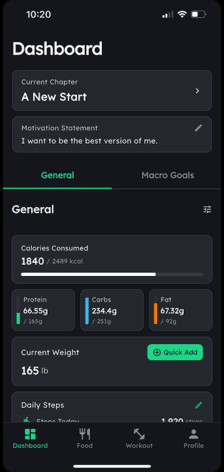
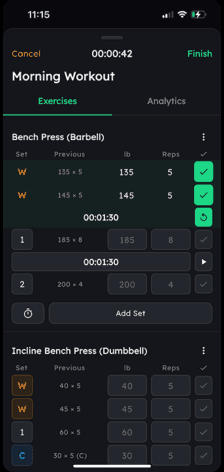
Track your performance, not just your weight. See real progress and stay motivated.
No commitment · Cancel anytime
What Are Performance Goals and Why Do They Work?
Performance goals shift your focus from what your body weighs to what your body can *do*. They are goals based on tangible, measurable improvements in your physical capabilities. They work because they are almost entirely within your control.
You control whether you go to the gym. You control the effort you put into lifting the weight. You control the choice to add 2.5 pounds to the bar. When you achieve that, it's a clear, undeniable win.
This creates a powerful positive feedback loop. You set a small goal -> you achieve it -> you feel successful and competent -> you are motivated to do it again. This is how sustainable habits are built.
Here are some examples of strong performance goals:
- Strength: Add 5 pounds to your deadlift every two weeks for the next two months.
- Strength-Endurance: Go from doing 3 sets of 8 reps on the bench press at 95 pounds to 3 sets of 12 reps.
- Skill: Perform one unassisted pull-up within the next 12 weeks.
- Cardio: Run a mile without stopping, regardless of the time it takes.
- Consistency: Complete 150 workouts in one year (a process goal that supports performance).
Unlike the scale, your performance log doesn't lie or fluctuate randomly. If you lifted 135 pounds last week and 140 pounds this week, that is real, measurable progress. It proves your hard work is paying off, even on days when the scale is being stubborn.
This shift in focus transforms your relationship with exercise. It stops being a punishment to burn calories and becomes a practice to build capability. You start seeing the gym as a place to get stronger and more confident, not just a place to shrink yourself.
How to Set Your First Performance Goal (3-Step Guide)
Ready to ditch the scale-watching for good? Here’s how to set a performance goal you can start working on this week. The key is to make it simple, measurable, and realistic.
Step 1: Pick Your Metric (What to Measure)
Don't try to improve everything at once. Choose 1-3 core exercises to focus on. Compound movements are best because they work multiple muscle groups and give you the biggest return on your effort. Good choices include:
- Lower Body: Barbell Squat or Leg Press
- Upper Body Push: Bench Press (barbell or dumbbell) or Overhead Press
- Upper Body Pull: Deadlift, Barbell Row, or Lat Pulldown
If you don't lift weights, you can choose a bodyweight or cardio metric:
- Bodyweight: Max number of push-ups, or time held in a plank.
- Cardio: Time to run one mile, or distance covered in 20 minutes.
Pick one and make it your primary focus. All other exercises in your workout are there to support your progress on this one lift or activity.
Step 2: Establish Your Baseline (Where You Are Now)
You can't know where you're going if you don't know where you are. During your next workout, find your baseline for your chosen exercise. A great way to do this is to find a weight you can lift for 3 sets of 8-10 repetitions with good, controlled form. The last 1-2 reps of each set should be challenging, but not impossible.
Write it down. For example: "Dumbbell Bench Press: 35 lbs per hand for 3 sets of 8 reps." This is your starting point. There is no ego here. It doesn't matter if the weight feels low; what matters is that it's an honest baseline you can build from.
Step 3: Set a Realistic, Short-Term Goal (Where You're Going Next)
Your goal for your very next session is not to add 20 pounds. It's to make a tiny, almost unnoticeable improvement. This is the essence of progressive overload.
Using the example above (35 lbs for 3x8), your goal for next week could be one of two things:
- Add Reps: Lift the same 35 lbs, but aim for 3 sets of 9 reps.
- Add Weight: Increase to 40 lb dumbbells and aim for 3 sets of 6 reps.
That's it. The goal is simple, clear, and 100% achievable with focused effort. Each time you hit that small goal, you've won. You've made progress. You are getting stronger. This is the engine of long-term motivation.
Your progress. Your proof. Your motivation.
See how far you've come in one simple view. Never doubt your hard work again.
No commitment · Cancel anytime
The "Side Effect": How Performance Goals Change Your Body
Here's the part that connects everything back to your original desire. You started by wanting to lose weight, and you might be thinking, "This is great, but will I actually look different?"
The answer is yes. In fact, you'll likely achieve the body you've been chasing more effectively than you would by focusing on the scale.
When you focus on getting stronger, you are giving your body a powerful reason to build and maintain muscle. This process, called body recomposition, is what truly changes your physique. More muscle tissue is metabolically active, meaning it burns more calories at rest. A body with more muscle and less fat at the same scale weight looks leaner, tighter, and more "toned."
Think about it: to lift heavier weights, your body must adapt. It strengthens connective tissues and builds new muscle fibers. This requires energy (calories). To recover and perform well, you'll naturally find yourself wanting to fuel your body with better food. You can't set a new deadlift personal record after a night of pizza and no sleep. Your performance goals will begin to dictate better lifestyle choices.
So while you're busy celebrating a new squat PR or finally doing an unassisted pull-up, something else is happening in the background. Your body fat percentage is decreasing. Your waist is getting smaller. Your clothes are fitting better. You are losing fat.
The aesthetic changes you want are a direct side effect of building a more capable, functional body. By focusing on performance, you get the visual results without the mental anguish of chasing a number on a scale.
Frequently Asked Questions
But will I still lose weight if I only focus on performance?
Yes. Focusing on getting stronger through progressive overload builds muscle. Muscle is metabolically active and burns more calories at rest. This process, combined with the better eating habits you'll adopt to fuel your workouts, creates an environment for fat loss. You'll achieve body recomposition-losing fat and gaining muscle-which is the visual change most people want.
What if I can't lift heavier every week?
That's completely normal and expected. Progressive overload isn't just about adding weight. You can also make progress by adding more reps with the same weight, adding another set, reducing your rest time between sets, or improving your form. Any of these is a measurable win.
Can I have both weight loss and performance goals?
Yes, but prioritize them correctly. Make performance your primary, weekly focus. Use the scale as a secondary data point, checking in only once a month to observe the long-term trend. Daily or even weekly weigh-ins will only distract you from the process that actually drives results.
What are good performance goals if I don't lift weights?
Excellent non-lifting performance goals include running a 5k in under 30 minutes, holding a plank for 2 minutes straight, doing 20 consecutive push-ups, or being able to do 10 perfect-form bodyweight squats. Pick something measurable that you can improve on over time.
How long until I see physical changes from performance goals?
You will feel stronger and more energetic within 2-4 weeks of consistent training. Visible physical changes, like clothes fitting better or seeing more muscle definition, typically take about 8-12 weeks. Trust the process and focus on your performance wins in the gym-the physical results will follow.
Conclusion
Stop letting a 3-digit number on the floor dictate your self-worth. Chasing performance is a game you can win every single week. The body you want isn't at the bottom of the scale; it's a side effect of building a stronger, more capable version of yourself. Pick a lift, set a small goal, and go earn your first win this week.
All content and media on Mofilo is created and published for informational purposes only. It is not intended to be a substitute for professional medical advice, diagnosis, or treatment. Always seek the advice of your physician or other qualified health provider with any questions you may have regarding a medical condition, including but not limited to eating disorders, nutritional deficiencies, injuries, or any other health concerns. If you think you may have a medical emergency or are experiencing symptoms of any health condition, call your doctor or emergency services immediately.