Is It Better to Log Rpe or Reps in Reserve for Muscle Growth

We hope you enjoy reading this blog post. Ready to upgrade your body? Try Mofilo Free
By Mofilo Team
Published
You’re trying to figure out is it better to log RPE or Reps in Reserve for muscle growth because what you're doing now feels like guesswork. You log your sets, reps, and weight, but some days 135 lbs for 8 reps feels easy and other days it feels like a max-effort lift. For building muscle, stop using the abstract RPE scale and switch to Reps in Reserve (RIR). It's a simpler, more direct way to guarantee you're training hard enough to grow.
Key Takeaways
- Reps in Reserve (RIR) is better for muscle growth because it asks a direct question: "How many more good-form reps could I have done?"
- The optimal intensity for muscle growth is consistently training with 1-3 Reps in Reserve on your main compound and accessory lifts.
- RPE (Rate of Perceived Exertion) and RIR are two sides of the same coin; you can calculate one from the other using the formula: RPE = 10 - RIR.
- An RIR of 2 is the same as an RPE of 8, but thinking in terms of RIR is more concrete and less subjective for most lifters.
- To calibrate your RIR, take one set of a safe isolation exercise (like a bicep curl) to absolute failure (0 RIR) so you know what true effort feels like.
- If you hit your target reps and your RIR is higher than planned (e.g., you had 4 reps left instead of 2), that is your signal to increase the weight in your next session.
What Are RPE and Reps in Reserve?
You see these acronyms in advanced training programs and they seem complicated, but they are just tools to measure effort. The problem is, one is a much better tool for the job of building muscle.
Reps in Reserve (RIR): The Direct Question
Reps in Reserve is exactly what it sounds like: the number of repetitions you have left in the tank at the end of a set. It answers one simple question: "If I had to, how many more reps could I have completed with good form before failing?"
If you do 8 reps of bicep curls and you know you could have done 2 more before your form broke down, you finished that set with a 2 RIR. It's a concrete number.
- 0 RIR: Absolute failure. You couldn't do another rep.
- 1 RIR: You had exactly one more good rep left.
- 2 RIR: You had two more good reps left. This is the sweet spot for most sets.
- 3-4 RIR: A solid effort, good for warm-ups or deload weeks.
Rate of Perceived Exertion (RPE): The Abstract Feeling
RPE is a 1-10 scale that measures your overall perception of effort. It was originally developed for endurance athletes to gauge cardiovascular effort, but it's been adapted for strength training.
Here’s how the scale translates:
- RPE 10: Maximum effort. You have 0 reps left (0 RIR).
- RPE 9: Very hard effort. You have 1 rep left (1 RIR).
- RPE 8: Hard effort. You have 2 reps left (2 RIR).
- RPE 7: Moderately hard effort. You have 3 reps left (3 RIR).
- RPE 6 and below: Warm-up or recovery effort.
The Simple Connection: RPE = 10 - RIR
As you can see, they are just inverse ways of measuring the same thing. An RPE of 8 is the same intensity as an RIR of 2. They are mathematically linked.
The debate isn't about which one represents a different level of intensity. The debate is about which one is a more practical and reliable tool for you to use in the gym to get results. For building muscle, RIR wins.

Stop guessing if you're training hard enough.
Track your RIR on every set. Know you're pushing for growth.
No commitment · Cancel anytime
Why Reps in Reserve Is Better for Muscle Growth
While RPE and RIR are mathematically related, thinking in terms of RIR is far more effective for hypertrophy training. It removes ambiguity and forces you to be more objective about your effort, which is the key to consistent progress.
RIR Is Concrete, RPE Is Abstract
Asking yourself "How hard did that feel from 1 to 10?" is a vague, abstract question. Your answer can be swayed by your mood, the music in your ears, or how much caffeine you had. One day a set feels like an RPE 9, and the next day the exact same weight and reps might feel like an RPE 7.
Asking "How many more reps could I have done?" is a concrete, physical question. It forces you to assess your actual remaining capacity. It's a much more stable and repeatable measurement of effort, which is what you need for a structured training plan.
RIR Is More Actionable
A program that says "3 sets of 8-12 reps at 2 RIR" gives you a clear stopping point. You perform reps until you know you only have 2 left in the tank, and then you stop the set. Whether that's 8 reps, 10 reps, or 12 reps, the *effort* is standardized.
This makes it easier to auto-regulate. If you're having a strong day, you might hit 12 reps at 2 RIR. On a low-energy day, you might only hit 9 reps at 2 RIR. In both cases, you achieved the correct stimulus for growth because the intensity (proximity to failure) was the same.
RIR Reduces Ego Lifting
The RPE scale, especially the allure of hitting an "RPE 10," can encourage people to push to failure too often and with sloppy form. Chasing a number on a feeling scale can lead to bad decisions.
In contrast, RIR is built around the idea of *leaving reps in the tank*. The goal is to hit a target like 2 RIR, not 0. This inherently encourages more controlled training, better form, and smarter progression. It shifts the focus from just finishing the set to finishing the set at the *right* intensity.
It's Easier for Beginners to Learn
For someone new to structured training, the concept of a 1-10 exertion scale is confusing. But asking "Could you do more?" is intuitive. Teaching a lifter to stop a set when they feel they have 2 good reps left is a much simpler coaching cue than trying to explain the subtle feeling difference between an RPE 7 and an RPE 8.
Your progress, proven in numbers.
See your weights and reps increase over time. Proof you're getting stronger.
No commitment · Cancel anytime
How to Start Using Reps in Reserve Today
Switching to RIR is simple and you can implement it in your very next workout. It just requires honesty and a single session to calibrate your internal effort-meter.
Step 1: Find Your Anchor Point (Calibrate Your Effort)
The biggest mistake people make with RIR is being too conservative. They think they have 2 reps left when they actually have 5. To fix this, you need to know what true failure feels like.
Pick a safe, low-risk isolation exercise like a machine chest press, leg extension, or a dumbbell bicep curl. After a few warm-ups, pick a weight you can do for about 10-15 reps. Perform a set to *absolute technical failure*-the point where you cannot complete another repetition with good form. That feeling is 0 RIR. Now you have an anchor. You know what the bottom of the scale feels like, which makes judging 1, 2, or 3 RIR much more accurate.
Do this once. You do not need to train to failure all the time. You just need to know where the limit is.
Step 2: Program Your Target RIR
For muscle growth, the scientific literature and decades of in-the-trenches experience point to the same conclusion: most of your work should be in the 1-3 RIR range. This is intense enough to trigger hypertrophy without accumulating excessive fatigue that kills your recovery.
- Compound Lifts (Squats, Bench, Rows): Aim for 2-3 RIR. These are technically demanding and systemically fatiguing. Pushing to 0 or 1 RIR too often is a recipe for burnout or injury.
- Accessory Lifts (Curls, Pushdowns, Raises): Aim for 1-2 RIR. These are less taxing, so you can push them a bit closer to failure more safely.
- Final Set Burnout: If you want to go to failure, save it for the final set of a single-joint machine exercise at the end of your workout. For example, a final set of tricep pushdowns to 0 RIR.
Step 3: Log Your Sets Correctly
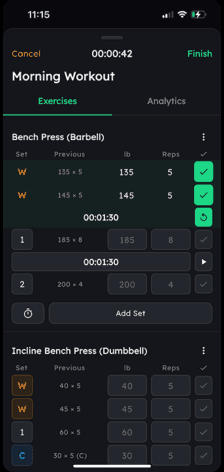
Your training log is now about more than just weight and reps. You need to track effort. A proper log entry looks like this:
Barbell Bench Press
- Set 1: 135 lbs x 10 reps @ 3 RIR
- Set 2: 155 lbs x 8 reps @ 2 RIR
- Set 3: 155 lbs x 7 reps @ 2 RIR
This log tells a story. You see that on the third set, your reps dropped from 8 to 7 at the same weight to maintain the same effort level (2 RIR). This is perfect. It shows you're managing fatigue correctly. If you had hit 10 reps at 2 RIR with 155 lbs, that's your signal to increase the weight to 160 or 165 lbs in your next session.
Common Mistakes When Logging RIR
Using RIR is a skill. You will get better with practice, but you can speed up the learning curve by avoiding these common pitfalls.
Mistake 1: Dishonesty (Ego Logging)
You finish a set of squats that felt like a 4 RIR, but you write down 2 RIR because that was the target in your program. This is the fastest way to stall your progress. The log is a tool for objective feedback, not a diary for your ego. Be brutally honest with yourself. If you missed your RIR target, just log what you actually achieved. That data is what tells you what to do next.
Mistake 2: Always Chasing Failure (0 RIR)
More is not always better. The stimulus for muscle growth happens several reps *before* you hit failure. Training to 0 RIR on every set, especially on heavy compound lifts, generates a massive amount of fatigue for very little additional muscle-building benefit. This fatigue accumulates, hurts your performance on subsequent exercises and workouts, and ultimately slows down your long-term progress.
Mistake 3: Not Adjusting the Weight
The entire purpose of tracking RIR is to guide progressive overload. If your program calls for 8-10 reps at 2 RIR and you hit 12 reps and it still felt like a 3 RIR, you are no longer training hard enough. That is a clear, unmissable signal that the weight on the bar is too light. In your next session, you must add weight-even if it's just 5 pounds-to bring your RIR back into the target range.
Mistake 4: Confusing Muscular Failure with Mental Quitting
Technical failure (0 RIR) is when you physically cannot perform another rep with good form. It is not the point where the set starts to feel uncomfortable or burn. Many lifters, especially beginners, stop a set when it gets hard, not when they are actually near their physical limit. This is another reason the initial anchor set is so important-it teaches you the difference between discomfort and true failure.
Frequently Asked Questions
What RPE/RIR is best for strength vs. hypertrophy?
For pure muscle growth (hypertrophy), aim for 1-3 RIR (RPE 7-9) in a rep range of 6-15. For pure strength, you'll use lower reps (1-5) and can use a wider RIR range of 2-5 (RPE 5-8) to manage fatigue and focus on bar speed and technique.
Should beginners use RPE or RIR?
Beginners should use RIR. It's a more intuitive concept. Asking "how many reps do you have left?" is much easier to understand and answer than asking a new lifter to rate their effort on an abstract 1-10 scale. It builds the skill of self-assessment from day one.
How often should I train to failure (0 RIR)?
Use it very sparingly. A good rule is to limit true failure training to the last set of a single-joint isolation exercise (like leg curls or cable flyes) once per week. Never take heavy, free-weight compound exercises like squats or deadlifts to 0 RIR.
Do RPE and RIR work for cardio?
The RPE scale was originally designed for cardiovascular exercise and works perfectly for it. Gauging your run as a "7 out of 10 effort" is a great way to manage intensity. RIR, however, is not applicable to steady-state cardio as there are no "reps."
Conclusion
Stop the guesswork. For building muscle, logging Reps in Reserve is a superior method to RPE because it's more direct, objective, and actionable. It provides the clear data you need to ensure every set contributes to your goal.
Start by being honest about how many reps you have left in the tank, log that number, and use it to guide your decisions about when to add weight. This is the path to consistent, predictable muscle growth.
All content and media on Mofilo is created and published for informational purposes only. It is not intended to be a substitute for professional medical advice, diagnosis, or treatment. Always seek the advice of your physician or other qualified health provider with any questions you may have regarding a medical condition, including but not limited to eating disorders, nutritional deficiencies, injuries, or any other health concerns. If you think you may have a medical emergency or are experiencing symptoms of any health condition, call your doctor or emergency services immediately.