Is It Better to Log Every Workout or Just the Hard Ones

We hope you enjoy reading this blog post. Ready to upgrade your body? Try Mofilo Free
By Mofilo Team
Published
You’re wondering is it better to log every workout or just the hard ones because logging feels like a chore. The answer is simple: you must log every single workout. Logging only your “hard” days is like only looking at your bank account after a big paycheck-it feels good, but it ignores the small daily expenses that actually determine if you’re getting ahead or falling behind.
Key Takeaways
- You must log every workout, including warm-ups and easy days, for a complete progress picture.
- Logging only "hard" workouts creates data gaps that hide the real reason you plateau.
- The purpose of a log isn't just to record personal bests; it's to manage fatigue and plan your next session.
- A simple log only needs four data points: Exercise, Weight, Sets, and Reps. Anything more is optional.
- Reviewing your log for 30 seconds before each workout is the single best way to ensure progressive overload.
- Missing a log entry is not a failure; just fill it in later or move on. Consistency beats perfection.
Why Logging "Just the Hard Ones" Fails You
Let's get straight to it. The idea of only logging your heavy deadlift days or when you hit a new bench press PR is tempting. It feels efficient. But it’s the single biggest mistake that keeps people stuck for months, or even years.
You are creating massive blind spots in your training. Progress in the gym isn't about isolated moments of glory; it's about the cumulative effect of all your work. The “easy” days, the accessory movements, and the deloads are just as important as the heavy singles.
The Incomplete Data Problem
Imagine you hit a new squat PR of 225 lbs for 5 reps. Awesome. You log it. But for the past three weeks, you've been skipping your final sets of leg press and hamstring curls because you were tired. You didn't log those because they weren't “hard” or impressive.
Suddenly, your squat stalls for a month. You have no idea why. Your log only shows the PR, not the slow decline in total volume that weakened your supporting muscles and led to the plateau. By not logging the “boring” stuff, you erased the evidence that would have told you exactly what was wrong.
The Fatigue Blindspot
Your body doesn't differentiate between “hard” and “easy” workouts in the way you think. It only understands total stress. That 30-minute arm workout you didn't log? It still costs recovery resources. That extra 15 minutes of cardio? It adds to your cumulative fatigue.
When you only log the hard days, you can't accurately track your total workload. You might feel burnt out and not know why. A complete log would show you that your total weekly sets have crept up from 50 to 85 over the last two months. The data makes the problem obvious: you need a deload week. Without it, you just feel weak and unmotivated.
The Illusion of Progress
Focusing only on PRs creates a fragile sense of accomplishment. You'll have weeks where you don't hit a new record. If that's your only measure of success, you'll feel like you're failing and be tempted to quit.
A complete workout log shows you other forms of progress. Maybe you didn't increase the weight on your bench press, but you did all your sets with cleaner form. Maybe you hit the same numbers as last week but felt stronger doing it. Maybe you cut your rest times by 15 seconds. These are all wins. Logging them provides the motivation to keep going when the big PRs aren't coming every week.

Stop guessing. Start growing.
Track your lifts in seconds. See your strength increase week by week.
No commitment · Cancel anytime
The Real Purpose of a Workout Log (It's Not What You Think)
Most people think a workout log is a diary to record their achievements. It's not. A workout log is not a history book; it's a map for the future. Its primary job is to tell you exactly what to do in your *next* workout to force your body to adapt.
Without a log, you're just guessing. You walk into the gym and try to remember what you did last Tuesday. Did you lift 135 or 140? For 6 reps or 8? This guesswork is why most people stop making progress after their first six months.
Purpose 1: To Guarantee Progressive Overload
Progressive overload is the non-negotiable principle of getting stronger and building muscle. It means continually making your workouts more challenging over time. The only way to do this systematically is to know what you did last time.
Your logbook is your target. If you benched 155 lbs for 3 sets of 8 reps last week, your goal today is clear:
- Bench 160 lbs for 3 sets of 6-8 reps.
- Or, bench 155 lbs for 3 sets of 9 reps.
- Or, bench 155 lbs for 4 sets of 8 reps.
Any of these is progress. Without the log, you're just throwing weights around and hoping for the best. With the log, you have a concrete, achievable mission for every single session.
Purpose 2: To Manage Recovery and Prevent Injury
Your log is your single best tool for managing fatigue. When you log every set of every exercise, you have a clear measure of your total training volume. If you start feeling run-down, sore, or your joints begin to ache, the log holds the answer.
You can look back and see if your total number of weekly sets has jumped too quickly. You can see if you've been pushing for PRs for too many weeks in a row without a deload. This data allows you to be proactive. Instead of training until you're forced to stop by burnout or injury, you can see the trend in your log and schedule a deload week to recover and come back stronger.
Purpose 3: To Build Unshakeable Motivation
Feelings are liars. You will have days where you walk into the gym feeling weak and small. You'll feel like you've made no progress. On these days, your workout log is your objective proof.
You can flip back two months and see you were struggling to dumbbell press 40 lb dumbbells for 6 reps. Today, you're warming up with them. That's real, undeniable progress. Seeing the numbers on the page provides a powerful psychological boost that subjective feelings can't touch. It proves the work is working, which is the fuel you need to keep showing up.
How to Log Every Workout Without It Feeling Like a Chore
Knowing you *should* log everything and actually *doing* it are two different things. The reason most people quit logging is that they make it too complicated. The key is to build a simple, fast system that becomes an automatic part of your workout ritual.
Step 1: Choose Your Tool (And Keep It Simple)
You have two good options: a physical notebook or a simple app. Don't get paralyzed by this choice. The best tool is the one you will use consistently.
- The Notebook: A simple, 50-cent spiral notebook and a pen is bulletproof. It never runs out of batteries, has no distracting notifications, and is incredibly fast. This is the best place to start.
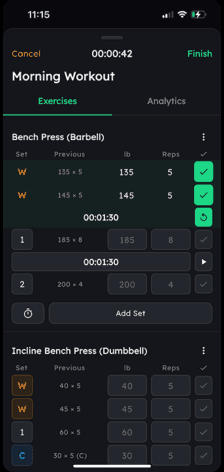
- An App: If you prefer digital, use an app like Mofilo that is designed for speed. It should allow you to quickly enter your lifts without navigating complex menus. Avoid apps that try to be a social network or a meal planner all-in-one.
Pick one and stick with it for at least a month.
Step 2: Log Only the "Big 4" Data Points
This is where people go wrong. They try to track rest times, RPE, tempo, and ten other variables from day one. It's too much. For your first year of serious training, you only need to log four things:
- Exercise Name: (e.g., Barbell Bench Press)
- Weight Used: (e.g., 135 lbs)
- Sets Completed: (e.g., 3)
- Reps Per Set: (e.g., 8, 8, 7)
That's it. A single entry looks like this: `Barbell Bench Press: 135 lbs x 3 sets (8, 8, 7)`. It takes 10 seconds to write.
Step 3: Build the 2-Minute Logging Habit
Do not wait until the end of your workout to log everything. You'll forget details or just decide not to do it. The habit is simple: Log your set during your rest period.
Finish your set of squats. Re-rack the weight. Walk to your notebook or phone. Log it. Then, and only then, do you sit down and rest. This entire process takes less than 20 seconds. By the time your workout is over, your log is already complete. There is no final administrative task to do.
What About Warm-ups, Cardio, and Deloads?
Yes, you log these too, but keep it even simpler. A single line item is enough.
- Warm-ups: `Treadmill - 10 min walk` or `Squat Warm-up: Barx10, 95x5, 135x3`.
- Cardio: `Stairmaster - 20 min, Level 8`.
- Deloads: This is where logging is critical. You log your reduced weights and sets to ensure you are actually deloading, not just taking it slightly easier. `Bench Press: 95 lbs x 3 sets of 8`.
This provides a complete record of all the work and stress you're putting your body through.
Your progress. All in one place.
Every workout logged. Objective proof that you are getting stronger.
No commitment · Cancel anytime
What to Do With The Data You've Logged
Collecting data is useless if you don't act on it. This is the final step that separates people who make consistent progress from those who spin their wheels. Using your log takes less than two minutes per workout, but it pays off with guaranteed gains.
The 30-Second Pre-Workout Review
Before you touch a single weight, open your log to the last time you performed today's main exercise. If it's squat day, find your last squat session. Look at the weight, sets, and reps you achieved.
This is now your target. Your entire goal for the workout is to beat those numbers in some small way. This 30-second review turns a vague session into a focused mission.
How to "Beat the Logbook"
"Beating the logbook" is the practical application of progressive overload. Your mission is to make today's entry slightly more impressive than the last one. Here are your options:
- Add Weight: If you did 3 sets of 8 with 185 lbs last time, try for 3 sets of 6-8 with 190 lbs today. This is the most common method.
- Add Reps: If you did 3 sets of 8, 7, 6 with 185 lbs last time, your goal today is to get 8, 8, 7 with the same weight.
- Add a Set: If you did 3 sets of 8 with 185 lbs, do 4 sets of 8 with the same weight.
Pick one method per exercise. This systematic approach is how you force your body to grow. It's no longer a guessing game.
Spotting Plateaus Before They Happen
After 4-6 weeks, you can use your log for analysis. Look at the progression of a specific lift, like your overhead press. Have the numbers been climbing consistently? Or have they been stuck at 95 lbs for 3x5 for the last three weeks?
Without a log, you just "feel" stuck. With a log, you have hard data proving it. This allows you to make an informed decision. Maybe it's time to switch to dumbbells for a few weeks. Maybe you need to add a new assistance exercise like lateral raises. The log gives you the diagnostic information you need to break through plateaus, rather than just running into them.
Frequently Asked Questions
What if I forget to log a workout?
Don't panic. One missing entry will not derail your progress. If you remember the details, fill it in later. If not, just forget it and make sure you log your next session. The goal is consistency, not 100% perfection. Missing one day is better than quitting altogether.
Is it okay to use a paper notebook instead of an app?
Absolutely. The best tool is the one you will use every time. A 50-cent notebook that you use is infinitely more effective than a sophisticated app that you don't. Start with paper; you can always switch to an app later if you want more features.
Should I log my RPE (Rate of Perceived Exertion)?
RPE is a great tool for intermediate and advanced lifters, but it adds complexity. For your first 6-12 months, focus exclusively on logging weight, sets, and reps. Master that habit first. Once logging is automatic, you can consider adding RPE to better manage fatigue.
Do I need to log rest times?
It's helpful for hypertrophy-focused training but not essential when you're starting out. The priority is logging the work itself. You can simply try to rest for a consistent amount of time, like 60-90 seconds between sets, without formally logging it at first.
How detailed should my exercise names be?
Just be consistent. "DB Bench Press" is better than writing "Dumbbell Press" one week and "Chest Press" the next. Consistent naming allows you to easily search for and track your progress on a specific movement over time. Find a name and stick with it.
Conclusion
Logging every workout isn't an obsessive chore; it's the most fundamental tool for turning your effort into measurable results. It removes the guesswork and provides a clear, logical path to getting stronger.
Stop thinking of it as work and start seeing it as the instruction manual for your own progress. Log your next workout, and the one after that. It's the simplest, most powerful change you can make to your training.
All content and media on Mofilo is created and published for informational purposes only. It is not intended to be a substitute for professional medical advice, diagnosis, or treatment. Always seek the advice of your physician or other qualified health provider with any questions you may have regarding a medical condition, including but not limited to eating disorders, nutritional deficiencies, injuries, or any other health concerns. If you think you may have a medical emergency or are experiencing symptoms of any health condition, call your doctor or emergency services immediately.