How to Use My Fitness App to See Why I Miss Workouts

We hope you enjoy reading this blog post. Ready to upgrade your body? Try Mofilo Free
By Mofilo Team
Published
You have the app. You have the plan. But you keep missing workouts and don't know why. It's a frustrating cycle of starting, stopping, and feeling guilty. This guide will show you how to stop guessing and start using your app as a tool to find and fix the real problem.
Key Takeaways
- Your fitness app is a diagnostic tool, not just a logbook for when you succeed.
- Use the notes feature to log the specific reason you miss a workout for at least 4 weeks to gather enough data.
- Common patterns for missed workouts are specific days (like Friday), times (after work), or preceding events (poor sleep).
- Aim for a 75-80% consistency rate, which is 3 out of 4 planned workouts; perfection leads to quitting.
- Fixing inconsistency is about changing your system (e.g., workout time or length), not about forcing more willpower.
- A missed workout is not a failure; it is a data point that tells you what isn't working.
What Your Fitness App Is Really For
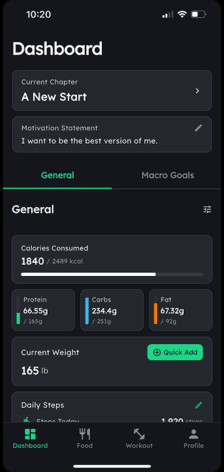
If you want to know how to use my fitness app to see why you miss workouts, you have to change your entire perspective on what the app does. It's not a gold-star chart for perfect attendance. It's a data collection device, and the most valuable data comes from your failures, not your successes.
Right now, you probably only open your app on good days. You log your sets, your reps, and your weights. You feel good seeing the entry. On bad days, you avoid the app entirely because opening it just reminds you that you skipped. This is the single biggest mistake.
A missed workout is a data point. The reason you missed it is the most important piece of information you can possibly track.
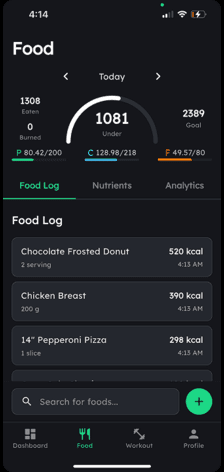
Think of it this way: your app tracks quantitative data-numbers like weight lifted, miles run, and dates you showed up. But the reason you miss workouts is qualitative data-the story behind the numbers. Things like "too tired from work," "slept less than 6 hours," or "felt intimidated by the workout."
Until you start logging the qualitative story alongside the quantitative numbers, you're only seeing half the picture. You're staring at a symptom (a missed workout) without ever diagnosing the cause.

Stop guessing why you're inconsistent.
Use Mofilo to track the real reasons and finally build a routine that sticks.
No commitment · Cancel anytime
Why "Just Trying Harder" Always Fails
You've probably told yourself this a hundred times: "This week, I'll be more disciplined." You rely on willpower to drag yourself to the gym after a long day. And it might work once or twice, but it's not a sustainable strategy.
Willpower is like a muscle. It gets fatigued. If you spend all day making tough decisions at work, resisting snacks, and dealing with stress, your willpower is exhausted by 5 PM. Expecting it to then power you through a 90-minute workout is unrealistic.
Missing workouts is almost never a character flaw. It's a system problem.
Your current fitness plan is clashing with the reality of your life. The friction is too high. Instead of trying to be a person with infinite motivation, your goal should be to find and reduce that friction. Your fitness app is the tool to locate it.
Here are common system problems that willpower can't solve:
- The Commute Barrier: The 20-minute drive to the gym feels like an hour after a long day.
- The Energy Deficit: You're trying to work out on an empty stomach or after a night of poor sleep.
- The Over-Ambitious Plan: Your workout is 90 minutes long, but you only realistically have a 60-minute window.
- The Dread Factor: You hate your workout plan (especially leg day), so you subconsciously find excuses to avoid it.
Trying to power through these issues with sheer grit is like trying to drive a car with the parking brake on. You might move a little, but you'll burn out fast. The smarter approach is to figure out how to release the brake.
Your patterns. Your progress. All clear.
See exactly what's holding you back. Build a plan that actually works for your life.
No commitment · Cancel anytime
The 3-Step Method to Find Your "Why"
This is a simple, data-driven process. It requires honesty and consistency for just one month. After 30 days, you will have a clear, undeniable answer to why you miss workouts.
Step 1: Track Every Planned Session for 4 Weeks
For the next four weeks, commit to opening your fitness app every single day you have a workout scheduled. No exceptions.
If you complete the workout, log it as you normally would. Great.
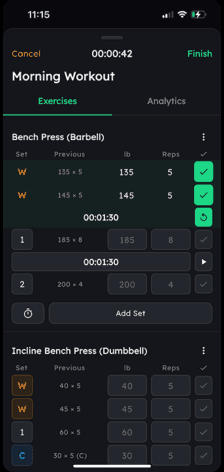
If you miss the workout, this is the crucial part: you must still create an entry. Create a dummy workout named "Missed Session" or something similar. Set the reps and weight to zero. The only thing that matters is creating an entry for that day so you can use the notes feature.
This act alone changes your relationship with the app. It's no longer a place to document wins; it's a place to document reality. You need a 4-week dataset to see patterns beyond a single bad week.
Step 2: Use the Notes Feature Like a Detective
In the notes section of every "Missed Session" entry, you will write down the honest, unfiltered reason you skipped. Don't judge it. Just record it. Be specific.
"Not feeling it" is not good enough. Dig one level deeper.
Good examples of notes:
- "Worked until 7 PM, no energy left."
- "Only slept 5 hours, felt exhausted all day."
- "Didn't eat enough for lunch, felt weak and dizzy."
- "Felt anxious about the crowds at the gym after work."
- "My shoulders were still sore from Monday's workout."
- "Had a social event come up last minute."
Log the reason, the time of day, and what you did instead. This isn't about shaming yourself; it's about collecting clues. After a few weeks, these clues will form a clear picture.
Step 3: Analyze the Data After 4 Weeks
After a month, open your app and review only the "Missed Session" entries. Ignore the successful workouts for now. Read through your notes. A pattern will emerge. It's almost guaranteed.
You will discover truths like:
- "Wow, I missed 3 out of 4 Friday workouts. I'm always burned out by the end of the week."
- "Every time I miss a workout, it's on a day I have that 4 PM meeting that runs late."
- "I've skipped leg day 50% of the time. I clearly dread this workout."
- "The days I skipped were all days I also forgot to pack my gym bag the night before."
This is the moment of breakthrough. You are no longer guessing. You have hard data staring you in the face. The problem is no longer a vague feeling of failure; it's a specific, solvable logistical issue.
How to Fix the Problems You Find
Once you've identified the pattern, the solution is usually straightforward. The goal is to adjust your system to fit your life, not force your life to fit an unrealistic system.
Problem: You always miss Friday workouts.
Solution: Stop fighting it. Make Friday an official rest day. Move that workout to Saturday or Sunday when you have more energy and time. Or, make Friday a 20-minute "fun" workout-something you genuinely enjoy, like playing a sport or going for a walk.
Problem: You're always too tired after work.
Solution: You have two options. First, try becoming a morning person. Wake up 45 minutes earlier and get it done before the day drains you. Second, if mornings are impossible, make your after-work session non-negotiably short. A 30-minute, high-intensity workout is far better than a skipped 90-minute one.
Problem: You consistently skip a specific workout (e.g., Leg Day).
Solution: Your workout is either too hard, too long, or too boring. Change it. Split it into two shorter sessions during the week (e.g., Quads on Tuesday, Hamstrings on Thursday). Or, replace the exercises you hate with ones you can tolerate. You don't have to squat if you hate it; Bulgarian split squats or leg presses work too.
Problem: You run out of time.
Solution: Your workouts are inefficient. Focus on compound movements that work multiple muscles at once (squats, deadlifts, overhead press, rows). You can get a world-class workout done in 45 minutes if you stop wasting time on isolation exercises with minimal return.
By fixing the system, you remove the friction. Consistency becomes effortless because your plan finally works *with* your life, not against it.
Frequently Asked Questions
What if my app doesn't have a notes feature?
Most quality fitness apps do, but if yours doesn't, use a separate tool. A simple notes app on your phone or even a physical pocket notebook works perfectly. Just write the date and the reason. The principle is the same: connect the missed day to the "why."
How long do I need to track to see a pattern?
Four weeks is the ideal timeframe. This captures a full month's cycle of work deadlines, social obligations, and energy fluctuations. Two weeks is the absolute minimum to get any meaningful data, but four weeks gives you an undeniable pattern.
What's a good workout consistency rate?
Aim for 75-80%. That means successfully completing 3 out of every 4 planned workouts. Chasing 100% perfection is a recipe for burnout and quitting. Life happens. A 75% success rate over a year will produce incredible results.
Should I feel guilty for missing a workout?
No. Guilt is a useless emotion that leads to quitting. A missed workout is not a moral failing; it is a data point. Treat it as such. Use it to learn and adjust your plan. The goal is progress, not perfection. Every missed session is an opportunity to make your system better.
Conclusion
Stop blaming your lack of motivation and start investigating your system. Your fitness app holds the key, but only if you use it to track your failures with the same diligence you track your successes. Follow this process for one month, and you'll trade frustrating guesswork for a clear, actionable plan.
All content and media on Mofilo is created and published for informational purposes only. It is not intended to be a substitute for professional medical advice, diagnosis, or treatment. Always seek the advice of your physician or other qualified health provider with any questions you may have regarding a medical condition, including but not limited to eating disorders, nutritional deficiencies, injuries, or any other health concerns. If you think you may have a medical emergency or are experiencing symptoms of any health condition, call your doctor or emergency services immediately.