How to Use a Workout Log to Actually Get Stronger

We hope you enjoy reading this blog post. Ready to upgrade your body? Try Mofilo Free
By Mofilo Team
Published
Going to the gym but not getting stronger is one of the most frustrating feelings in fitness. A workout log is the tool that fixes this, but only if you use it as a roadmap for the future, not a diary of the past.
Key Takeaways
- Your log's only purpose is to enable progressive overload, which means doing slightly more work over time.
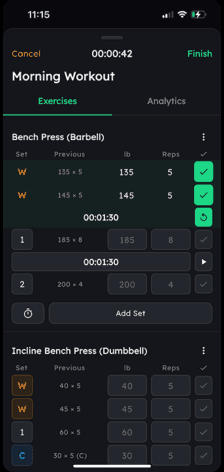
- For every main exercise, you must track three things: the weight lifted, the reps completed for each set, and the total number of sets.
- Before your next workout, review your last one and set a tiny goal: add just one more rep or 2.5-5 lbs to the bar.
- Use the "Double Progression" model: keep the weight the same while adding reps until you hit a target range (e.g., 12 reps), then increase the weight.
- A good log turns the question "What should I do today?" into a clear mission: "Today, I need to beat 135 lbs for 8 reps."
- If you fail to progress for two weeks straight, it's a signal to take a deload week, not a sign that you're failing.
What a Workout Log Is Actually For (It's Not a Diary)
To learn how to use a workout log to actually get stronger, you must shift your mindset: a log isn't for remembering what you did, it's for planning how to do *more* next time. This is the fundamental difference between simply exercising and actively training.
Exercising is showing up and moving your body. You burn some calories, get a sweat on, and feel good. It's random. One day you do leg press, the next you do leg extensions. The weights are whatever feels right that day.
Training is strategic. It's a structured process with the specific goal of getting stronger, building muscle, or improving performance. The tool that makes this possible is your workout log.
Its only job is to facilitate Progressive Overload. This is the non-negotiable principle of getting stronger. It means methodically increasing the demand placed on your muscles over time. You lift a little more weight, do one more rep, or perform an extra set. Your body adapts to this new demand by getting stronger.
Without a log, you are guessing. You're relying on memory to recall what you lifted last Tuesday. Did you do 135 lbs for 8 reps, or was it 145 lbs for 6? You don't know. So you just pick a weight that feels challenging and repeat the cycle of not making real progress.
A log removes the guesswork. It provides objective data.
- Diary Mindset: "Monday - Bench Press, 3 sets of 10 reps."
- Training Mindset: "Last Monday I did 135 lbs for 10, 9, 8 reps. My goal for this Monday is 135 lbs for 10, 10, 8 reps. I am aiming for just one more rep on my second set."
That small shift is everything. It gives every workout a purpose. You're no longer just going through the motions; you're on a mission to beat your past self. That's how you build real, measurable strength.

Stop guessing. Start getting stronger.
Track your lifts. See your strength grow week by week.
No commitment · Cancel anytime
Why Your Current "Logging" Isn't Working
You might already be using a notebook or an app, but your strength is still stuck. You're putting in the work, but the numbers on the bar aren't moving. This happens because of a few common, fixable mistakes.
Mistake 1: Vague or Incomplete Entries
Your log says "Squats, 3 sets." This is useless information. It tells you nothing about the intensity or volume. Was it 95 lbs or 225 lbs? Were the sets for 5 reps or 15 reps? Without specific numbers for weight and reps per set, you have no target to beat for next time.
Your entry needs to be precise. For example: "Barbell Back Squat: 185 lbs x 8, 8, 7." This tells you exactly what you did. You hit 8 reps on the first two sets and fatigued to 7 on the last. Now you have a clear goal for next week: get 8, 8, 8.
Mistake 2: Not Reviewing the Log Before You Train
This is the single biggest error people make. They diligently record their workout, close the notebook, and don't open it again until they're standing in front of the squat rack a week later. The planning phase is lost.
The review is more important than the recording. You must look at your previous workout's numbers *before* you start the current one. This five-minute process turns your log from a historical document into an actionable plan. It sets your intention for the session.
Mistake 3: Only Trying to Add Weight
You think the only way to progress is to add more plates to the bar. You benched 155 lbs for 3 sets of 8 last week, so this week you try 165 lbs. You fail, only getting 4 or 5 reps. Discouraged, you drop back to 155 lbs and feel defeated.
This ignores the most reliable way to progress: adding reps. Getting one extra rep with the same weight is a clear sign of getting stronger. Your log proves this. Going from 8 reps to 9 reps at 155 lbs is a victory. Once you can do 10-12 reps at that weight, moving up to 165 lbs will feel manageable.
Mistake 4: Inconsistent Tracking
You track for two weeks, feel motivated, then forget your notebook for a week. Or you only track your "good" days and skip logging the bad ones. This creates gaps in your data and breaks the chain of progressive overload.
Consistency is the engine of progress. A log with three months of consistent data, even with slow progress, is infinitely more valuable than a log with a few amazing workouts scattered over a year. Every session, good or bad, provides information.
The 3-Step System to Use Your Log for Strength Gains
This is the exact system to turn your workout log into a strength-building machine. It's simple, requires no fancy equipment, and it works.
Step 1: Record the Three Essential Metrics
For every primary exercise in your routine, you must log these three things. No exceptions.
- Exercise Name: Be specific. "DB Incline Bench Press" is better than "Chest Press." This ensures you're comparing apples to apples each week.
- Weight Lifted: Write down the exact weight in pounds or kilograms. Include the bar's weight (a standard Olympic barbell is 45 lbs).
- Reps Per Set: Do not write "3x8." Write out the reps you achieved on each individual set, like "8, 8, 7." This shows you where your strength fades and gives you a micro-goal for your next session.
An optional but highly effective metric is RPE (Rate of Perceived Exertion). It's a scale from 1-10 describing how hard the set felt, where 10 is absolute failure. A set of "135 lbs x 8 (RPE 9)" tells you that you had exactly one rep left in the tank. This context is incredibly valuable for making smart progressions.
Step 2: Review and Plan Before Every Workout
This takes five minutes and is the most important habit you will build. Before you start your workout (or even the night before), open your log to the same workout from the previous week.
Look at the numbers. Create a concrete, achievable goal for today.
- Last Week's Log: "Overhead Press: 95 lbs x 6, 5, 5"
- Today's Written Goal: "Overhead Press: 95 lbs x 6, 6, 5"
Your entire mission for that exercise is to get one more rep on the second set. That's it. This small, clear target is motivating and drives consistent, incremental progress. You're no longer just lifting; you're competing against your logbook.
Step 3: Execute Using a Progression Model
Now you have a plan. When you get to the gym, your job is to execute. Here are the two most effective models for progressing.
- Double Progression (Best for most people): This is the gold standard for long-term gains. You progress reps first, then weight.
- Choose a rep range (e.g., 8-12 reps for muscle growth, 4-6 for strength).
- Select a weight you can lift for 3 sets at the bottom of that range (e.g., 3 sets of 8).
- Each week, keep the weight the same and focus only on adding reps.
- Once you can successfully complete all sets at the top of the rep range (e.g., 3 sets of 12), you've earned the right to increase the weight.
- Add 5-10 lbs, drop your reps back to the bottom of the range (3x8), and repeat the process.
- Linear Progression (Best for beginners): This is the simplest method and works incredibly well for the first 6-12 months of training.
- Pick a set and rep scheme (e.g., 3 sets of 5 reps).
- Each workout, add a small amount of weight (2.5 or 5 lbs) and perform the same 3x5.
- You continue adding a little weight every single session until you can no longer complete all the reps. When that happens, it's time to switch to Double Progression.
Weeks of progress. All in one place.
Every workout logged. Proof you're getting stronger.
No commitment · Cancel anytime
What to Expect (A Realistic Timeline for Strength)
Using a workout log correctly provides predictable results. But progress isn't always a straight line up. Here’s a realistic look at what your journey will look like.
For Beginners (Months 0-6):
This is the "newbie gains" phase. Your body is highly responsive to training. You can expect to add weight to your primary lifts almost every single week. Using a linear progression model, adding 5 lbs to your squat and deadlift and 2.5 lbs to your bench and overhead press each session is a realistic goal. Your log will be incredibly motivating as you see big jumps in strength.
For Intermediates (Months 6-24):
Progress inevitably slows down. This is normal and a sign that you're no longer a beginner. You will not be able to add weight every week. This is where most people get frustrated and quit, thinking their program has stopped working.
Your log is your proof that it *is* working. Your focus shifts from adding weight every week to adding *one rep* every week. Progress now looks like this:
- Week 1: 185 lbs x 8, 8, 8
- Week 2: 185 lbs x 9, 8, 8
- Week 3: 185 lbs x 9, 9, 8
- Week 4: 185 lbs x 9, 9, 9
It might take a full month to add just one rep to all three sets. This is excellent progress for an intermediate lifter. After another month, you might hit 3x12 and finally earn the right to move up to 190 lbs.
Plateaus and Deloads:
You will have bad days. You will have weeks where you fail to beat your logbook. If this happens for one week, don't panic. It could be due to poor sleep, stress, or nutrition. If you fail to progress for two or three consecutive weeks, your log is sending you a clear signal: it's time for a deload.
A deload is a planned week of reduced intensity. You'll go to the gym but lift at 50-60% of your usual weights for the same number of sets and reps. This gives your joints, nervous system, and muscles a chance to recover fully. After a 7-day deload, you'll come back feeling stronger and ready to break through the plateau.
Frequently Asked Questions
Should I use a notebook or an app?
Use whichever tool you will stick with consistently. A simple $2 notebook is foolproof and distraction-free. An app can offer helpful features like rest timers and automatic volume calculations, but can also be distracting. Start with a notebook; you can always switch later.
What if I can't beat my log for two weeks in a row?
This is a clear signal that you need to recover. First, check your sleep, stress, and nutrition. If those are in order, it's time for a deload week. Reduce your training intensity to about 50-60% for 5-7 days. This allows for recovery and almost always leads to breaking the plateau when you return.
How much detail is too much?
You must track weight, reps, and sets for your main compound lifts (like squats, deadlifts, bench press, overhead press, and rows). For smaller, single-joint accessory exercises like bicep curls or tricep pushdowns, focusing on good form and getting close to failure is more important than hitting exact numbers.
What does RPE mean and should I track it?
RPE stands for Rate of Perceived Exertion. It's a 1-10 scale of how hard a set felt, with 10 being absolute failure. Tracking it provides valuable context. A set of 8 reps at RPE 7 is very different from 8 reps at RPE 10. It helps you make smarter decisions about when to push for more reps or weight.
How do I log supersets or circuits?
Keep it simple. List the exercises with a letter-number combination (A1, A2, B1, B2). For example: "A1: DB Bench Press: 50lbs x 10" followed by "A2: Bent Over Row: 95lbs x 12". Note the rest period you took after completing the pair, then repeat for your next set.
Conclusion
A workout log is not a passive record of your gym sessions; it is your active plan for getting stronger. It transforms random effort into structured, measurable progress.
Stop exercising and start training. Use your log to plan your next small victory before you even touch a weight, and you will never be stuck again.
All content and media on Mofilo is created and published for informational purposes only. It is not intended to be a substitute for professional medical advice, diagnosis, or treatment. Always seek the advice of your physician or other qualified health provider with any questions you may have regarding a medical condition, including but not limited to eating disorders, nutritional deficiencies, injuries, or any other health concerns. If you think you may have a medical emergency or are experiencing symptoms of any health condition, call your doctor or emergency services immediately.