How to Do Progressive Overload With Resistance Bands

We hope you enjoy reading this blog post. Ready to upgrade your body? Click here
By Mofilo Team
Published
Progressive overload is the single most important principle for building muscle, period. But with bands, it can feel confusing and random. This guide gives you a clear, step-by-step system that works.
Key Takeaways
- Progressive overload with bands requires a system; you can't just stretch the band more and hope for the best.
- The four methods of overload are: increasing reps, adding sets, increasing resistance (by combining bands), and increasing time under tension.
- Aim for the 8-15 rep range. Once you can complete 15 reps with perfect form, it's time to make the exercise harder.
- Tracking your workouts is non-negotiable. You must write down the band, reps, and sets to ensure you're progressing.
- To bridge the large gap between bands, combine a lighter band with your current one to create incremental resistance.
- Form always comes first. Adding more resistance with bad form leads to injury, not growth.
What Is Progressive Overload (And Why It Feels Impossible With Bands)
The secret to understanding how to do progressive overload with resistance bands is to stop thinking about them like dumbbells. You're probably frustrated because you can’t just add 5 pounds. You have a 25-pound band and a 40-pound band, and the jump between them feels like a mile. This is a real problem, and it's why most people who try to get strong with bands give up.
Progressive overload simply means making your muscles work harder over time. If the demand on the muscle doesn't increase, it has no reason to adapt and grow stronger or bigger. With weights, this is easy: you add a 2.5-pound plate to the bar. Simple math.
With bands, the resistance isn't fixed. It changes throughout the movement, getting harder as you stretch it. This variable resistance is great for muscle activation but a nightmare for tracking progress. How do you measure progress when the “weight” is constantly changing?
You feel stuck. You do more reps, but 30 reps of a bicep curl feels more like cardio than strength training. You try the next band up, and you can barely do 3 reps with terrible form. It feels like you're either spinning your wheels or heading for an injury.
This is where a system becomes critical. Instead of relying on just one method of progression (a heavier band), you need to use four. When you have multiple ways to increase the difficulty, you can always find a way to challenge your muscles and force them to grow.

Stop guessing. Start getting stronger.
Track your band workouts. See your strength grow week by week.
No commitment · Cancel anytime
The 4 Methods for Progressive Overload With Bands
Forget just pulling harder. Real progress comes from a structured approach. Here are the four methods you will use, often in combination, to get stronger with bands. Master these, and you'll never feel stuck again.
Method 1: Increase Repetitions
This is your starting point. It’s the most straightforward way to increase the total work your muscles do. We use a system called the "Double Progression Model."
First, define a rep range. For muscle growth (hypertrophy), the 8-15 rep range is perfect. Pick a band that allows you to perform an exercise for at least 8 reps, but no more than 15, with perfect form.
Here’s the plan:
- Start with a band where you can do 3 sets of 8 reps (3x8).
- Each workout, try to add 1-2 more reps to each set.
- Your goal is to work your way up to 3 sets of 15 reps (3x15).
- Once you can successfully complete 3x15 with clean form, you have “earned the right” to increase the resistance. You are now officially stronger.
Method 2: Increase Resistance (The Smart Way)
This is where most people get it wrong. They make the huge jump to the next band and fail. The key is to make the jump smaller.
Combine Bands: Don't just switch from the blue band to the black band. Use the blue band *and* the yellow (lightest) band at the same time. This creates a resistance level that's in between the two, allowing for a much smoother progression. For example, if your blue band is 25 lbs and your black is 40 lbs, adding a 10-lb yellow band to your blue one gives you a 35-lb resistance to bridge the gap.
Pre-Stretch the Band: Anchor the band further away from you. If you're doing a chest press, take a step forward before you start. This adds tension from the very beginning of the movement, making the entire exercise harder without changing the band.
Method 3: Increase Sets
Let's say you're stuck at 3 sets of 12 reps and just can't seem to get to 13. Instead of banging your head against the wall, just add another set. Doing 4 sets of 12 reps is more total volume than 3 sets of 12 reps. It's a simple way to increase the workload without changing reps or resistance. Once you can handle the extra set, you'll often find you have the strength to push for more reps in your original sets.
Method 4: Increase Time Under Tension (TUT)
This is an advanced technique that dramatically increases difficulty. Instead of just lifting the weight, you control the tempo. Use a 3-1-2-1 count:
- 3 Seconds Eccentric (Lowering): Take a full three seconds to lower the resistance. Fight the band as it tries to pull you back.
- 1 Second Pause: Pause for one second at the bottom of the movement.
- 2 Seconds Concentric (Lifting): Take two seconds to perform the main lift.
- 1 Second Squeeze: Squeeze the target muscle for one full second at the peak of the contraction.
A single rep now takes 7 seconds. Doing 8 reps with this tempo is far harder than 15 fast, sloppy reps. This method forces your muscles to stabilize and control the load, creating a powerful stimulus for growth.
Weeks of progress. All in one place.
Every workout logged. Proof you're getting stronger.
No commitment · Cancel anytime
How to Structure Your Band Workouts for Growth
Knowing the methods is one thing; applying them is another. A good workout isn't random. It's a plan. Here’s how to build one that guarantees you're making progress.
Step 1: Choose Your Core Exercises
Don't get lost in endless exercise variations. Focus on the big, compound movements that work multiple muscle groups at once. This gives you the most bang for your buck. Your workout plan should be built around 5-7 of these key exercises:
- Lower Body: Banded Squats, Romanian Deadlifts (RDLs), Glute Bridges
- Upper Body Push: Banded Chest Press, Overhead Press
- Upper Body Pull: Banded Rows, Banded Pull-Aparts
Pick one or two exercises from each category for a full-body routine you can do 3 times a week.
Step 2: Establish Your Baseline
For your very first workout, your only goal is to gather data. For each exercise, find the band and setup that challenges you in the 8-15 rep range. Write it down. You might do 10 reps on squats with the black band, but 14 reps on rows with the blue band. That's fine. This is your starting point.
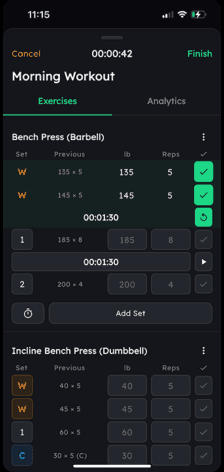
Your log for Day 1 might look like this:
- Banded Squats: Black Band, 3 sets of 10 reps.
- Banded Rows: Blue Band, 3 sets of 14 reps.
- Banded Chest Press: Blue Band, 3 sets of 9 reps.
Now you have a baseline. The game has begun.
Step 3: Track Everything and Beat the Logbook
This is the most important step. Your goal for every single workout is to look at your last performance and beat it in some small way. This is how you ensure progressive overload.
Your logbook is your map. Before you start your second workout, you look at your numbers from Day 1. Your mission is clear:
- Banded Squats: Last time was 3x10. Today, you'll aim for 3x11.
- Banded Rows: Last time was 3x14. Today, you'll aim for 3x15. If you get it, you know next time you need to add resistance.
- Banded Chest Press: Last time was 3x9. Today, you'll aim for 3x10.
This is it. This is the whole secret. A simple log, and a commitment to beat that log every time. It removes all the guesswork and proves you are getting stronger.
What to Do When You Max Out Your Heaviest Band
Eventually, you might get so strong that even your heaviest band feels too easy for 15 reps. This is a great problem to have, and it doesn't mean you have to buy weights. Here are four strategies to continue making progress.
Option 1: Combine Your Bands
This is the most obvious solution. If your 80-pound band is too light, combine it with your 40-pound band for 120 pounds of resistance. You can continue combining bands to create new levels of resistance for a long time.
Option 2: Master Time Under Tension (TUT)
Even if a band feels easy with a normal tempo, it will feel brutal if you slow it down. Try a 5-2-3-2 tempo. That's a 5-second negative phase. An overhead press with an 80-pound band using a 5-second negative is an incredibly advanced movement that will challenge even very strong individuals.
Option 3: Decrease Rest Times
If you normally rest 90 seconds between sets, cut it to 60 seconds. Then 45. This increases metabolic stress and cardiovascular demand, forcing your body to adapt in a different way. You're increasing the density of your workout by doing the same amount of work in less time.
Option 4: Switch to Unilateral Exercises
Instead of doing a two-handed chest press, switch to a single-arm chest press. This instantly doubles the demand on the working side and requires immense core stability. The same applies to rows, presses, and leg exercises. A banded single-leg RDL is an advanced exercise that will challenge your strength, balance, and stability all at once.
Frequently Asked Questions
Can you actually build significant muscle with only resistance bands?
Yes, absolutely. Your muscles respond to tension and mechanical stress, not the tool creating it. As long as you apply consistent progressive overload and challenge yourself within the 8-15 rep range, your muscles will grow.
How many times a week should I train with bands?
For most people, 3 to 4 full-body workouts per week is the sweet spot. This frequency allows you to stimulate your muscles enough for growth while still giving them about 48 hours to recover between sessions.
What's a good rep range for building muscle with bands?
Stick to the 8-15 rep range for your main compound lifts. If you can easily do more than 15 reps with perfect form, the resistance is too light and it's time to progress using one of the four methods.
Are expensive bands better than cheap ones?
Not always, but quality matters for durability and safety. Look for layered latex bands, as they are less likely to snap than cheaper, molded bands. A set of 5-6 bands with varying resistance levels is far more useful than one single expensive band.
How do I know if my form is correct?
Record yourself with your phone. Watch the playback and compare it to tutorial videos. You're looking for smooth, controlled movement. If you see yourself jerking, using momentum, or breaking form on the last few reps, the resistance is too high.
Conclusion
Progressive overload with resistance bands isn't about magic; it's about math and measurement. Stop treating your workouts like a random collection of exercises and start treating them like a science experiment.
Pick your exercises, establish your baseline, and then commit to beating your logbook every single week. That is the path to real, measurable strength.
All content and media on Mofilo is created and published for informational purposes only. It is not intended to be a substitute for professional medical advice, diagnosis, or treatment. Always seek the advice of your physician or other qualified health provider with any questions you may have regarding a medical condition, including but not limited to eating disorders, nutritional deficiencies, injuries, or any other health concerns. If you think you may have a medical emergency or are experiencing symptoms of any health condition, call your doctor or emergency services immediately.