How Many Carbs Should I Eat on Rest Days When Cutting

We hope you enjoy reading this blog post. Ready to upgrade your body? Try Mofilo Free
By Mofilo Team
Published
Figuring out your diet while cutting feels complicated enough. Then you throw in rest days, and the confusion doubles. You want to keep losing fat, but you don't want to feel completely drained for your next workout. This guide gives you the direct, no-BS math.
Key Takeaways
- Your total weekly calorie deficit is far more important than daily carb adjustments.
- On rest days, a good starting point is 0.5 to 0.75 grams of carbs per pound of your body weight.
- Keep your protein intake high and consistent every day, especially when cutting, aiming for 0.8-1.2 grams per pound of body weight.
- To maintain your calorie deficit on rest days, increase your fat intake to compensate for the calories removed from carbs.
- Carb cycling is an optional tool for managing energy and hunger; it is not a requirement for fat loss.
- If your performance in the gym suffers, your rest day carbs are likely too low. Adjust them upwards slightly.
Why Rest Day Carbs Cause So Much Confusion
The direct answer to 'how many carbs should I eat on rest days when cutting' is less than you eat on training days, but definitely not zero. For most people, aiming for 0.5 to 0.75 grams of carbs per pound of body weight is the perfect starting point. You're probably worried that eating carbs on a day you don't train will immediately turn to fat, or that cutting them too low will leave you with zero energy for your next leg day. Both are valid fears.
Here’s the truth: your body doesn't operate on a strict 24-hour clock. The most important factor for fat loss is your total calorie deficit averaged over the week. Whether you eat 150 grams of carbs on Monday and 100 on Tuesday is less important than hitting your weekly calorie target.
The entire point of adjusting carbs on a rest day isn't to unlock some secret fat-burning mode. It's simply about energy management. On days you lift heavy, you need more carbohydrates to fuel the workout and begin replenishing muscle glycogen. On days you're sedentary, your immediate energy needs are lower.
By slightly lowering carbs and increasing fats on rest days, you accomplish two things:
- You provide your body with the energy it needs for basic functions and recovery without an excess of carbs it doesn't immediately require.
- You increase dietary fats, which are crucial for hormone regulation and can improve satiety, making it easier to stick to your deficit.
Think of it as a budget. Your total calories are your daily budget. Protein is a fixed expense. Carbs and fats are your variable expenses that you can adjust based on the day's activities.

Stop guessing your rest day macros.
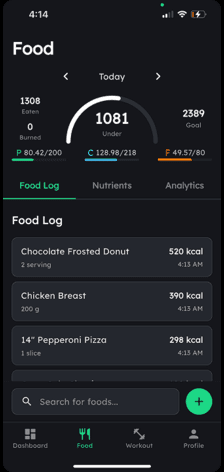
Track your food. Know you are hitting your numbers for cutting, every single day.
No commitment · Cancel anytime
The Two Common Mistakes People Make
Most people who try to manage rest day nutrition fall into one of two traps. They either overcomplicate it or oversimplify it, and both lead to frustration.
Mistake 1: Keeping Everything Exactly the Same
This isn't necessarily a huge mistake, and it's better than the alternative. If you're in a calorie deficit, you will lose fat. Period. However, eating the same high-carb meal plan on a day you sit at a desk as you do on a day you squat 225 pounds can be suboptimal.
You might feel a bit sluggish or bloated. More importantly, you miss an opportunity. By keeping carbs high, you have to keep fats lower to stay within your calorie budget. Healthy fats are vital, and a rest day is a perfect time to give your body more of them without sacrificing workout performance.
Mistake 2: Dropping Carbs to Zero
This is the more common and damaging mistake. You think, "No workout, no carbs." So you eat nothing but chicken and broccoli all day. By 3 PM, you have a headache, you're irritable, and you can't focus. The next day, you get under the bar and feel incredibly weak.
Your brain's primary fuel source is glucose, which comes from carbohydrates. Your muscles also need to replenish the glycogen stores you depleted during your last workout. Dropping carbs to zero starves your brain and hinders recovery. A rest day is a recovery day, not a punishment day.
Never go to zero. A baseline of at least 50-75 grams of carbs is necessary for most people just to support brain function and basic physiological processes. Going lower than that offers no benefit and comes with significant downsides to your mood, energy, and future performance.
How to Calculate Your Rest Day Carbs (Simple Math)
Let's get rid of the guesswork. We'll use a 180-pound person as an example. The goal is to keep total calories and protein the same on both training and rest days, while simply swapping some carbs for fats.
Step 1: Establish Your Cutting Calories
First, you need to be in a calorie deficit. A simple way to estimate your daily maintenance calories is to multiply your body weight in pounds by 14-16. Let's use 15.
180 lbs x 15 = 2,700 calories (maintenance)
To create a sustainable deficit, subtract 300-500 calories.
2,700 - 400 = 2,300 calories per day for cutting.
Step 2: Set Your Protein (Non-Negotiable)
Protein is your anchor. It preserves muscle mass while you're in a deficit. Aim for 1 gram per pound of body weight.
180 lbs = 180 grams of protein.
Protein has 4 calories per gram: 180g x 4 = 720 calories from protein.
Step 3: Calculate Your Training Day Macros
On training days, you want more carbs to fuel performance. A good target is around 1 gram of carbs per pound of body weight.
Carbs: 180g. (180g x 4 = 720 calories)
Now, fill the remaining calories with fat. Fats have 9 calories per gram.
Total Calories: 2,300
Protein Calories: 720
Carb Calories: 720
Remaining Calories for Fat: 2,300 - 720 - 720 = 860 calories
Fat Grams: 860 / 9 = ~95 grams of fat.
Training Day Summary (180-lb person):
- Calories: 2,300
- Protein: 180g
- Carbs: 180g
- Fat: 95g
Step 4: Calculate Your Rest Day Macros
Here's where the change happens. Keep calories and protein the same. Lower your carbs to the 0.5-0.75g per pound range. Let's use 0.75g for our example.
Carbs: 180 lbs x 0.75g = 135 grams of carbs.
Carb Calories: 135g x 4 = 540 calories.
Now, fill the remaining calories with fat.
Total Calories: 2,300
Protein Calories: 720
Carb Calories: 540
Remaining Calories for Fat: 2,300 - 720 - 540 = 1,040 calories
Fat Grams: 1,040 / 9 = ~115 grams of fat.
Rest Day Summary (180-lb person):
- Calories: 2,300
- Protein: 180g
- Carbs: 135g
- Fat: 115g
As you can see, you simply swapped 45 grams of carbs (180 calories) for about 20 grams of fat (180 calories). It's that simple.
Your macros. Every day. On track.
No more confusion. See your carb, protein, and fat targets and know you hit them.
No commitment · Cancel anytime
What to Expect and When to Adjust
Implementing this strategy is straightforward, but it's important to have realistic expectations and know when to make changes.
This approach is for you if:
- You are already consistently tracking your calories and macros.
- You want to optimize your energy levels and satiety while cutting.
- You follow a structured training plan with distinct high-intensity and rest days.
This approach is probably not for you if:
- You are a complete beginner. Your first priority should be building the habit of tracking calories and hitting your protein goal consistently.
- You aren't in a calorie deficit. Carb cycling doesn't cause fat loss; a deficit does.
- Your activity level is roughly the same every day (e.g., you do light cardio daily but don't have intense lifting sessions).
When you start, you shouldn't feel a dramatic difference overnight. The goal is stability. You might notice you feel less bloated on rest days and more mentally sharp due to the higher fat intake. The real test is your next workout. You should feel well-rested and just as strong as you did the previous week.
How to know if you need to adjust:
- If your workout performance drops: Your rest day carbs are too low. Increase them from 0.75g/lb to 0.85g/lb and see how you feel. Make small, 15-20g adjustments.
- If you feel excessively hungry on rest days: The lower carbs and higher fats should improve satiety, but if they don't, you can try shifting a few more carbs from your training day to your rest day.
- If you feel great and performance is solid: Don't change anything. You've found a good balance.
Listen to your body's performance signals. The numbers on the page are a starting point; your energy in the gym is the ultimate feedback.
Frequently Asked Questions
Should I lower my total calories on rest days?
You can, but it adds another layer of complexity. It's much simpler to keep your calories consistent and just adjust your macros. Focusing on a consistent weekly average deficit is what drives fat loss, and keeping daily calories the same makes tracking easier.
Will lower carbs on rest days hurt my muscle growth?
No. As long as your total calorie intake is adequate and your protein intake is high (0.8g/lb or more), your body will have the resources it needs to repair and maintain muscle. Your muscles will have plenty of time to replenish glycogen before your next workout.
What are good carb sources for rest days?
On rest days, prioritize high-fiber, high-volume carbohydrates that promote fullness. This includes leafy green vegetables, broccoli, cauliflower, and berries. A small portion of a starchy carb like sweet potato, oats, or quinoa is also fine to support energy levels.
Is carb cycling necessary to lose belly fat?
Absolutely not. A consistent calorie deficit is the only thing necessary to lose fat from your entire body, including your belly. Carb cycling is just an optional strategy to manage your energy and hunger within that deficit. It is not a magic bullet.
Conclusion
Stop thinking of rest days as a nutritional puzzle. The goal is simply to align your fuel source with your day's energy demands while maintaining your calorie deficit. Lower carbs slightly, increase fats, and keep protein high.
Use the math in this guide as your starting point, listen to your body, and focus on what truly matters: consistency and effort over time.
All content and media on Mofilo is created and published for informational purposes only. It is not intended to be a substitute for professional medical advice, diagnosis, or treatment. Always seek the advice of your physician or other qualified health provider with any questions you may have regarding a medical condition, including but not limited to eating disorders, nutritional deficiencies, injuries, or any other health concerns. If you think you may have a medical emergency or are experiencing symptoms of any health condition, call your doctor or emergency services immediately.