How Many Calories Am I Miscalculating by Not Weighing Sauces and Oils

We hope you enjoy reading this blog post. Ready to upgrade your body? Try Mofilo Free
By Mofilo Team
Published
If you're asking 'how many calories am I miscalculating by not weighing sauces and oils,' you're already ahead of 90% of people. You're frustrated because you're doing everything 'right'-tracking your chicken, rice, and veggies-but the scale isn't moving. The answer is simple and frustrating: you are likely miscalculating by 300-500 calories per day, completely wiping out your intended deficit.
Key Takeaways
- Not weighing sauces and oils can easily add 300-500+ uncounted calories to your daily total, which is enough to stall all fat loss.
- One tablespoon of olive oil is 14 grams and has 120 calories. A quick 'glug' from the bottle is often 2-3 tablespoons (240-360 calories).
- A food scale is the only tool for accuracy. Measuring spoons are wildly inaccurate for calorie-dense liquids and butters.
- To weigh accurately, place your pan on the scale, press 'tare' to zero it out, then pour your oil. The number you see is the exact weight to log.
- Focus on weighing the biggest offenders first: cooking oils, butter, nut butters, and creamy salad dressings. These account for 80% of miscalculations.
- For restaurant meals, assume a minimum of 2 tablespoons of hidden fats (240+ calories) in any cooked dish and 4 tablespoons in any creamy dressing.
Why 'Eyeballing' Is Sabotaging Your Fat Loss
You're not crazy. You're tracking your food, staying under your calorie goal, and maybe even adding in extra cardio. But your weight is stuck. The culprit isn't your metabolism; it's the unmeasured tablespoon of olive oil in your pan and the 'healthy' vinaigrette on your salad.
Let's be brutally direct. When you 'eyeball' oils and sauces, you are not in a calorie deficit. You just think you are.
Here’s the math that ruins progress:
- 1 Tablespoon of Olive Oil: 14 grams = ~120 calories.
- Your 'Glug' of Olive Oil: When you pour oil from the bottle to coat a pan, you're not using one tablespoon. You're using two or three. That's 28-42 grams, or 240-360 calories. You just added a small meal's worth of calories before your food even touched the pan.
Consider a 'healthy' lunch. You have 150g of grilled chicken breast (248 calories), 200g of broccoli (68 calories), and 150g of white rice (195 calories). Total: 511 calories. Perfect.
But you cooked the chicken and broccoli in a 'splash' of oil. Let's call it 2 tablespoons (240 calories). Now your meal is 751 calories. You do this again for dinner. Suddenly, your '1800-calorie' day is actually a 2280-calorie day. You've just erased a 480-calorie deficit.
This isn't an exaggeration. This is the single most common reason people fail at fat loss. They focus on the volume of food (chicken, rice) while ignoring the calorie density of the things they cook it in (oil, butter, sauce).
Your body doesn't care about your intentions. It only cares about the final energy balance. Until you account for these hidden calories, you will remain stuck.

Your calorie deficit isn't working. Here's why.
Track your food with Mofilo. Find the hidden calories and finally see results.
No commitment · Cancel anytime
The Biggest Calorie Offenders You Aren't Weighing
Not all unweighed items are created equal. You don't need to worry about the calories in a squirt of mustard. You absolutely need to worry about the fats. Fats have 9 calories per gram, while protein and carbs have only 4. This density is why they are so easy to over-consume.
Focus your energy on these four categories. They account for the vast majority of tracking errors.
1. Cooking Oils and Butter
This is the number one offender. Olive oil, coconut oil, avocado oil, butter, ghee-they are all functionally the same from a calorie perspective. They are pure fat. A tiny amount contains a huge number of calories. Pouring these freely is like pouring liquid fat onto your fat loss goals.
- The Error: A quick pour to coat a pan.
- The Reality: 25-40g of oil (225-360 calories).
2. Nut Butters
The label says '2 tablespoons' is a serving (190 calories). But nobody uses a level, measured tablespoon. You use the spoon you eat with. A heaping dinner spoon of peanut butter isn't 32 grams; it's closer to 50 or 60 grams.
- The Error: A 'big spoonful' of almond butter in your oatmeal.
- The Reality: 55g of almond butter (340 calories), not the 190 you logged.
3. Salad Dressings and Mayonnaise
A 'healthy' salad becomes a calorie bomb because of the dressing. Creamy dressings like Ranch, Caesar, and Blue Cheese are primarily oil and fat. A standard serving is 2 tablespoons, which is around 140-160 calories. Most people use double or triple that to coat a large salad.
- The Error: Drizzling ranch over your salad until it 'looks right'.
- The Reality: 4-5 tablespoons of dressing (280-350 calories).
4. Liquid Sweeteners and Creamers
That swirl of honey in your Greek yogurt or the 'splash' of heavy cream in your coffee adds up fast. These are often forgotten because they feel insignificant. They are not.
- The Error: A 'splash' of half-and-half in your two daily coffees.
- The Reality: A real splash is about 2 tablespoons (40 calories). Two coffees mean 80 uncounted calories per day. Over a week, that's 560 calories-enough to slow your progress.
If it's a fat or a sugar and it's liquid, it needs to be weighed.
How to Accurately Weigh Sauces and Oils (The Right Way)
This process seems tedious for the first three days. Then it becomes second nature. It takes an extra 15 seconds per meal, and it is the single most effective change you can make to guarantee your calorie deficit is real.
Step 1: Buy a Digital Food Scale
This is not negotiable. A good food scale costs $15. It is the most important fitness tool you can own, more than any supplement or piece of gym equipment. Measuring spoons and cups are for baking cakes, not for accurately tracking calorie-dense foods.
Step 2: Use the 'Tare' Function for Everything
The 'tare' or 'zero' button is your best friend. It subtracts the weight of the container, so you only measure what you're adding.
For Cooking Oil:
- Place your cooking pan on the scale.
- Press the 'TARE' button. The scale will now read '0 g'.
- Pour your oil directly into the pan. Stop when the scale reads your desired amount (e.g., '7 g' for half a tablespoon, or '14 g' for a full one).
- Remove the pan and cook. You just measured with 100% accuracy.
For Sauces or Peanut Butter:
- Place your bowl or plate on the scale.
- Press 'TARE' to zero it out.
- Spoon the sauce or peanut butter onto your food. The scale will show you the exact weight you added.
Step 3: Log in Grams, Not 'Tablespoons'
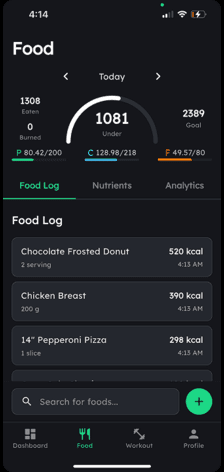
This is the crucial final step. Open your tracking app and search for 'Olive Oil'. Do not select the entry for '1 tbsp'. Scroll down and find the entry for '1 g'. Enter the exact number of grams from your scale. This eliminates all the estimation and inaccuracy of volumetric measurements. Fourteen grams is always fourteen grams. A 'tablespoon' can be anything.
Step 4: Handle Restaurant Food with Smart Estimates
You can't bring a food scale to a restaurant. Here, you have to accept imperfection and make an educated guess. Always overestimate.
- For Salads: Assume the dressing is at least 4 tablespoons. Find 'Ranch Dressing' in your app and log 4 servings.
- For Cooked Dishes: Assume any meat or vegetable dish was cooked with at least 2 tablespoons of oil or butter. Log 28g of olive oil or butter.
This isn't perfect, but it's far better than ignoring it. By logging a conservative estimate of 250-400 calories from hidden fats, you're much closer to the truth.
Every calorie tracked. Results you can see.
Stop guessing if you're in a deficit. Know your numbers and watch the scale move.
No commitment · Cancel anytime
What to Expect When You Start Weighing Everything
Getting serious about weighing your oils and sauces will trigger a series of predictable events. Knowing them ahead of time will keep you from getting discouraged.
First Week: The 'Oh, That's Why' Moment
The first time you weigh your 'normal' pour of oil and see '38g' on the scale (342 calories), you will have a revelation. It will all click into place. You weren't failing; you were working with bad data. This isn't a moment of shame. It's a moment of empowerment. You've found the problem.
Second Week: The Plateau Finally Breaks
Once you start logging these calories accurately, you will adjust your portions to fit within your *true* calorie target. And within 7-14 days, the scale will start moving down again. The 'whoosh' you've been waiting for will happen because you are finally, consistently in a calorie deficit. This is the reward for your diligence.
Third Week: It Becomes Effortless
What felt tedious and obsessive in week one is now automatic. You barely think about it. You put the pan on the scale, press tare, pour, and log. The entire process adds less than 30 seconds to your meal prep. It feels as normal as washing your hands before you cook.
Fourth Week and Beyond: Food Freedom
Counterintuitively, this strictness leads to freedom. When you know with 100% certainty that you've eaten 1,650 calories by dinnertime, you know you have exactly 350 calories left for the evening. You can have a measured bowl of ice cream or a couple of cookies with zero guilt, because you know it fits. This is far more liberating than 'eating clean' all day and then feeling guilty about a snack because you're not sure if you 'earned' it.
Weighing your food isn't a prison. It's the map that shows you the way out.
Frequently Asked Questions
How do I weigh sticky things like peanut butter or honey?
Place the entire jar on the food scale and press 'tare' to zero it out. Take your scoop of peanut butter. The negative number on the scale (e.g., '-35g') is the exact amount you took. Log 35 grams.
Are 'zero calorie' sauces and dressings truly zero calories?
No. FDA regulations allow products with fewer than 5 calories per serving to be labeled as '0 calories'. The serving sizes are often ridiculously small, like 1/4 teaspoon. If you use 10 servings of a 'zero calorie' sauce, you could be consuming 40-50 calories. It's not a huge amount, but it is not zero.
Is it worth weighing ketchup and mustard?
For 99% of people, no. These are very low-calorie condiments. A tablespoon of mustard is about 3 calories, and ketchup is about 20. Unless you are drinking the bottle, these are not the source of your plateau. Focus your energy on high-fat, calorie-dense items first.
This feels obsessive. Do I have to do this forever?
No. The goal is to do this strictly for 4-8 weeks to re-calibrate your perception. After weighing your oil 50 times, you will learn exactly what 10 grams looks like in a pan. You can then transition to eyeballing with much greater accuracy. But whenever you hit a future plateau, the first thing you should do is go back to weighing everything for one week to check your assumptions.
Conclusion
That nagging feeling that you're doing something wrong is valid, but the solution is simple. The 15 seconds it takes to weigh your cooking oil is the difference between spinning your wheels for months and seeing consistent, predictable progress week after week. Stop guessing and start measuring. This is the fix.
All content and media on Mofilo is created and published for informational purposes only. It is not intended to be a substitute for professional medical advice, diagnosis, or treatment. Always seek the advice of your physician or other qualified health provider with any questions you may have regarding a medical condition, including but not limited to eating disorders, nutritional deficiencies, injuries, or any other health concerns. If you think you may have a medical emergency or are experiencing symptoms of any health condition, call your doctor or emergency services immediately.