How Do I Know If I'm Squatting Deep Enough

We hope you enjoy reading this blog post. Ready to upgrade your body? Try Mofilo Free
By Mofilo Team
Published
The world of squatting is full of confusing advice. You hear "ass to grass," "90 degrees," and a dozen other cues that leave you wondering what's right. This guide gives you one clear, simple standard that works.
Key Takeaways
- The correct squat depth is achieved when your hip crease drops just below the top of your kneecap. This is known as "breaking parallel."
- Filming yourself from a side-on, knee-level angle is the only reliable way to check your squat depth accurately.
- "Ass to grass" (ATG) depth is not required for muscle growth and can increase injury risk if you lack the necessary mobility.
- If you can't hit proper depth, poor ankle mobility is the most common reason. Your heels lifting off the ground is the biggest sign.
- Expect to reduce the weight on the bar by 20-30% when you start squatting to full depth. This is a necessary step for long-term progress.
- A slight forward lean with your chest is normal and required; trying to stay perfectly upright is a myth that limits depth for most people.
What Is "Deep Enough" for a Squat?
To answer the question of how do I know if I'm squatting deep enough, you need one simple, universal rule: your hip crease must drop below the top of your kneecap. That's it. This is the gold standard known as "breaking parallel."
Imagine drawing a horizontal line from the top of your knee. At the bottom of your squat, the crease where your thigh meets your hip must be below that line. Anything less is a partial rep.
You've probably felt the frustration. You load up 185 pounds, do a set of 8, but your legs don't seem to be growing. You feel it more in your back than your quads. This is almost always a depth problem. A 135-pound squat to full depth is infinitely more effective for building muscle than a 225-pound half-squat.
Why is breaking parallel the standard? Because it ensures a full range of motion for your quads and glutes. When you cut the squat high, you're primarily using your quads. When you break parallel, you fully engage the powerful muscles of your glutes and hamstrings, leading to more growth and strength.
Forget the other cues you've heard:
- "90 Degrees": This is vague and often misinterpreted. People think it means their hamstrings should be parallel to the floor, which is actually a high squat. Breaking parallel is deeper than this.
- "Ass to Grass" (ATG): This is a term from Olympic weightlifting that requires elite mobility. For general fitness and muscle building, it's unnecessary and, for many, risky. It often leads to the lower back rounding, a problem called "butt wink."
Your goal is simple and repeatable: hip crease below the knee on every single rep. This is the standard that builds real strength and muscle.

Stop guessing if your squat is deep enough.
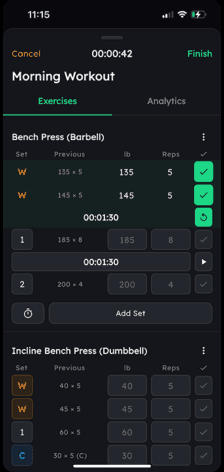
Track your lifts with video. See your form improve and your strength grow.
No commitment · Cancel anytime
Why Most People Squat Too High
If breaking parallel is the standard, why do you see so many people in the gym doing half-squats? It boils down to two things: ego and mobility.
First, ego. The squat is a benchmark lift, and nobody wants to be seen lifting a "low" number. The truth is, you can move a lot more weight with a partial range of motion. A person who half-squats 225 pounds might only be able to properly squat 155 pounds. It's tough to accept that drop, so people stick with heavy, ineffective reps.
This is a trap. Progress is measured by increasing weight *at the same depth*. If you add 10 pounds to the bar but cut your depth by two inches, you didn't get stronger. You just cheated the movement.
Second, and more common, are mobility restrictions. Your brain might be telling your body to go lower, but your joints and muscles physically cannot get into position without something going wrong. The two biggest culprits are your ankles and hips.
- Poor Ankle Mobility: This is the #1 reason people can't squat deep. If your ankles can't bend enough (a movement called dorsiflexion), your body has to compensate. As you go down, your heels will lift off the floor to create more room. This throws you off balance and puts immense stress on your knees. Most people who say "squatting deep hurts my knees" actually have an ankle mobility problem.
- Tight Hips: If your hip flexors and adductors are tight, they can prevent your femurs from moving freely. As you try to squat deeper, your pelvis gets pulled under, causing your lower back to round. This is the dreaded "butt wink," and it puts your lumbar spine in a vulnerable position.
Many people squat high because they are subconsciously avoiding the point where their mobility runs out and the movement feels unstable or painful. They stop right before their heels lift or their back rounds, which is almost always above parallel.
How to Check and Improve Your Squat Depth (The 3-Step Method)
You can't fix what you can't see. Looking in the mirror from the front is useless for judging depth. You need objective feedback. Here is the exact process.
Step 1: Film Yourself Correctly
This is non-negotiable. Take your phone and prop it up on a dumbbell or water bottle. Position it so it's filming you directly from the side. The camera lens should be at the same height as your knees will be at the bottom of your squat. This perspective is critical.
Use a light weight-or even just the empty barbell-that you know you can control. Perform a set of 5 reps, focusing on going as deep as you can with good form.
Step 2: Analyze the Video
Now, be an honest coach. Play the video back and pause it at the very bottom of each rep. Look for one thing: the relationship between your hip crease and the top of your knee.
Is the crease of your hip clearly below the top of your kneecap? If yes, congratulations, you're squatting to depth. If it's at the same level or higher, you're doing a partial squat.
Also, watch your lower back. Do you see it round or tuck under at the very bottom? That's a butt wink. It means you've gone slightly too deep for your current mobility. Your goal is to squat to the lowest point *before* that rounding occurs.
Step 3: Identify and Fix Your Limiter
Based on the video, you can now diagnose the problem.
- If your heels lift off the ground: You have an ankle mobility issue. As a temporary fix, squat with your heels elevated on a pair of 5 or 10-pound plates. This will allow you to hit depth immediately. For a long-term fix, perform wall ankle stretches daily. Face a wall, place your foot 4-5 inches away, and try to touch your knee to the wall without your heel lifting. Hold for 30 seconds on each side.
- If your lower back rounds (butt wink): You have a hip mobility issue or are simply trying to force depth you don't have. Stop your squat just before the rounding begins. Work on hip mobility drills like the '90/90 stretch' and deep goblet squats, where you hold a light dumbbell and use your elbows to push your knees out at the bottom.
- If you feel like you'll fall backward: This is often a combination of tight ankles and a weak core. The temporary fix is the same: elevate your heels. Also, switch to Goblet Squats for a few weeks. Holding a dumbbell in front of you acts as a counterbalance, making it easier to sit back and stay balanced while you build the motor pattern.
Your true strength, finally unlocked.
Every workout logged. Proof you're squatting right and getting stronger.
No commitment · Cancel anytime
What to Expect When You Fix Your Depth
Making the switch from partial reps to full-depth squats is a humbling process, but it's where real progress begins. Here’s what will happen.
Your Lifting Weight Will Drop Immediately
This is the first and most important thing to accept. You will have to lower the weight on the bar, likely by 20-30%. If you were half-squatting 225 lbs, you may find your true parallel squat is closer to 155-175 lbs. This is not a step backward. It's a correction. You are now building a real foundation.
You Will Feel Your Glutes and Quads More
Prepare for a new kind of soreness. A full-depth squat recruits significantly more muscle fiber in your glutes and hamstrings. The day after your first true squat session, you'll feel muscles you didn't know you had. This is a clear sign that the lift is now working as intended.
Your Progress Will Become More Consistent
Once you establish a consistent, full range of motion, your progress becomes measurable and real. Adding 5 pounds to the bar means you actually got 5 pounds stronger, because the movement is identical week to week. This is how you break through plateaus. Within 4-8 weeks of dedicated practice, your strength will likely surpass your old half-squat numbers, but now with legitimate form.
Your Knees May Feel Better
This is counterintuitive for many, but proper deep squats are often better for knee health than partials. When you cut a squat high, it creates more shearing force on the knee joint. A full squat, where the hamstrings can support the knee at the bottom, creates more compressive force, which the joint is better designed to handle. As long as your knees track over your feet and don't cave in, you're building stability around the joint.
Embrace the process. The initial drop in weight is a small price to pay for building real, functional strength and unlocking your true growth potential.
Frequently Asked Questions
Is "Ass to Grass" (ATG) squatting better?
Not for most people. ATG requires elite-level hip and ankle mobility. While it provides a slightly greater range of motion, the extra muscle-building benefit is minimal compared to a parallel squat. For many, forcing ATG leads to lower back rounding (butt wink), which increases injury risk.
What if I have knee pain when I squat deep?
This is almost always a form or mobility issue, not a depth issue. First, film yourself to ensure your knees are tracking in line with your feet and not caving inward. Second, check for heel lift, a sign of poor ankle mobility. Elevating your heels on small plates can often fix this instantly.
How much should my chest lean forward?
Your torso should be roughly parallel to your shins at the bottom of the squat. A forward lean is not only normal but necessary to keep the bar over your mid-foot. People with longer legs will need to lean forward more than people with shorter legs. Trying to stay perfectly upright is a myth.
Do I need weightlifting shoes?
Weightlifting shoes have a solid, elevated heel that helps you squat deeper by compensating for poor ankle mobility. They are a very effective tool but not mandatory. You can mimic the effect by placing 5-10 lb plates under your heels to see if it helps you hit depth more easily.
Can I just do leg press instead?
The leg press can build quad muscle, but it is not a substitute for the squat. Squats train your entire body to work as a system, building core strength, stability, and balance that the leg press machine completely removes. Use the leg press as an accessory, not a replacement.
Conclusion
Stop the guesswork. The standard for an effective, muscle-building squat is when your hip crease drops below your kneecap. Film yourself, be honest about your form, and accept the temporary weight reduction needed to do it right. This is the path to real strength and results.
All content and media on Mofilo is created and published for informational purposes only. It is not intended to be a substitute for professional medical advice, diagnosis, or treatment. Always seek the advice of your physician or other qualified health provider with any questions you may have regarding a medical condition, including but not limited to eating disorders, nutritional deficiencies, injuries, or any other health concerns. If you think you may have a medical emergency or are experiencing symptoms of any health condition, call your doctor or emergency services immediately.