Can You Follow a Gym Routine at Home

We hope you enjoy reading this blog post. Ready to upgrade your body? Click here
By Mofilo Team
Published
Following a structured fitness plan is the only way to get real results. But the cost, commute, and crowds at a commercial gym can be a major barrier. This leaves many people wondering if they can get the same benefits from working out at home.
Key Takeaways
- Yes, you can follow a gym routine at home by applying the principle of progressive overload, not by using fancy machines.
- You only need three core pieces of equipment to start: adjustable dumbbells, an adjustable bench, and a set of resistance bands.
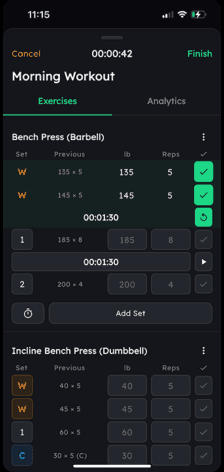
- The key to making progress is tracking your lifts-sets, reps, and weight-every single week, just as you would in a gym environment.
- You can effectively replicate over 90% of common gym machine exercises using a combination of free weights and bands.
- Your results are determined by the consistency and intensity of your training, not the location where you perform it.
- A successful home routine focuses on 5-6 core compound movements and aims to increase reps or weight weekly.
Why Most Home Workouts Fail (And What a "Gym Routine" Really Is)
The direct answer to 'can you follow a gym routine at home' is an absolute yes, but not by following the random, high-rep cardio circuits you see all over social media. The reason most home workouts fail is that they lack the single most important principle of getting stronger and building muscle: progressive overload. They feel hard, but they don't build anything long-term.
You're probably frustrated. You've tried following along with free videos. You sweat, you get tired, but after a few weeks, you look and feel exactly the same. You see people posting their gym progress and wonder if the machines and heavy barbells are a magic ingredient you're missing. They're not.
A "gym routine" isn't about the location or the equipment. It's a structured system for doing more work over time. That's it. It’s about lifting a weight for 8 reps one week and pushing for 9 reps the next. It’s about lifting 40 pounds for 12 reps, and then moving up to 45 pounds the following week. This forces your muscles to adapt and grow.
Most home workouts are just glorified cardio. They have you doing endless squat jumps and push-up variations with no clear way to make them harder next week. Your body adapts in 1-2 sessions, and then your progress stalls completely. A real routine is a plan. It’s measurable. It’s predictable. And you can absolutely build one at home.

Build real muscle. At home.
Track your home lifts. See your strength grow week by week.
No commitment · Cancel anytime
The Only 3 Pieces of Equipment You Actually Need
Forget the expensive treadmills, ellipticals, and complicated all-in-one home gym machines. They are unnecessary and take up a massive amount of space. To build a physique that rivals what you can achieve in a commercial gym, you only need three versatile tools. This setup will cover 90% of your needs for less than the cost of a one-year gym membership.
1. Adjustable Dumbbells (The Foundation)
This is your number one investment. Instead of buying a whole rack of individual dumbbells that take up an entire wall, a single pair of adjustable dumbbells gives you a weight range from 5 lbs up to 50 lbs, or even 90 lbs. This is the key to progressive overload at home. When you get stronger, you just turn a dial to add more weight. For most people, a set that goes up to 50 lbs is more than enough to build a fantastic physique.
2. An Adjustable Bench (The Multiplier)
An adjustable bench is the force multiplier for your dumbbells. Without it, you're stuck doing floor presses and a few standing exercises. With a bench, you unlock dozens of new movements. You can set it to a flat, incline, or upright position. This allows you to perform exercises like the Incline Dumbbell Press for your upper chest, Seated Dumbbell Shoulder Press, and Supported Dumbbell Rows for your back. It provides stability and proper positioning, which is crucial for lifting safely and effectively.
3. Resistance/Pull-Up Bands (The Machine Replacer)
This is the secret weapon for replicating machine-based exercises. A good set of resistance bands costs less than $50 and allows you to perform movements that are otherwise impossible without a cable machine. You can do face pulls for shoulder health, tricep pushdowns for your arms, and assisted pull-ups to build back strength. They are also perfect for warming up and adding resistance to bodyweight movements like squats and glute bridges.
How to Apply Progressive Overload at Home
This is where the magic happens. Progressive overload is the process of making your workouts slightly harder over time. Your muscles will not grow unless you give them a reason to. Here is the simple, three-step system to ensure you are constantly making progress.
Step 1: Pick Your 5 Core Lifts
Don't try to do 20 different exercises. Focus on the compound movements that give you the most bang for your buck. With your dumbbells and bench, you can create a full-body routine around these five lifts:
- Goblet Squats (or Dumbbell Front Squats): For your quads, glutes, and core.
- Dumbbell Bench Press (Flat or Incline): For your chest, shoulders, and triceps.
- Dumbbell Bent-Over Rows: For your back and biceps.
- Seated Dumbbell Shoulder Press: For your shoulders.
- Dumbbell Romanian Deadlifts (RDLs): For your hamstrings and glutes.
These five exercises work nearly every muscle in your body. Perform this workout 3 times per week on non-consecutive days (e.g., Monday, Wednesday, Friday).
Step 2: Establish Your Baseline
In your very first workout, your goal is to find your starting weight for each exercise. Pick a weight and aim for 3 sets of 8-12 reps. The right weight is one where the last 2 reps of each set are very difficult, but you can still complete them with good form. If you can easily do 15 reps, the weight is too light. If you can't even get 6 reps, it's too heavy. Find that sweet spot and write down the weight, sets, and reps for every exercise.
Step 3: Progress Every Single Week
This is the most important step. Each week, your goal is to beat your numbers from the previous week. You have two primary ways to do this:
- Add Reps: If you did 3 sets of 8 reps on the bench press with 40 lbs last week, your goal this week is to get 3 sets of 9 reps with the same 40 lbs.
- Add Weight: Once you can comfortably perform 3 sets of 12 reps with a certain weight, it's time to increase the load. Go up to 45 lbs and drop your reps back down to 8. Then, you start the process of adding reps all over again.
By tracking this and always pushing to do a little more, you guarantee progress. Your body has no choice but to adapt by getting stronger and building muscle.
Your home gym progress, proven.
Every set and rep logged. Proof you're getting stronger without the gym.
No commitment · Cancel anytime
How to Substitute Common Gym Exercises at Home
One of the biggest mental blocks to working out at home is feeling like you're missing out on essential machines. You're not. Nearly every single-joint machine exercise can be replicated, and often improved upon, with free weights and bands. Here’s how to replace the most common gym machines.
Instead of the Leg Press Machine...
Do Goblet Squats or Bulgarian Split Squats. These free-weight movements are superior because they not only work your quads and glutes but also force you to engage your core and stabilizer muscles, leading to more functional, real-world strength.
Instead of the Lat Pulldown Machine...
Do Band-Assisted Pull-Ups or Dumbbell Rows. If you have a doorway pull-up bar, use your resistance bands to assist you. If not, heavy dumbbell rows performed on your bench are one of the best back-builders, period. They build thickness in a way a lat pulldown cannot.
Instead of the Cable Chest Fly Machine...
Do Dumbbell Flys on your adjustable bench. Performing these on a flat or incline bench provides a deep stretch and contraction for your chest. You have to control the weight through the entire range of motion, which recruits more muscle fibers than a fixed-path machine.
Instead of the Seated Leg Curl Machine...
Do Dumbbell Romanian Deadlifts (RDLs). RDLs are a far more effective hamstring and glute exercise. They teach you the proper hip-hinge pattern and build strength through your entire posterior chain, which is critical for athleticism and preventing back pain.
Instead of the Tricep Pushdown Cable...
Do Overhead Dumbbell Tricep Extensions or Band Pushdowns. You can do extensions seated or standing with one or two dumbbells. Alternatively, anchor a resistance band to the top of a door and perform pushdowns just as you would with a cable machine.
Frequently Asked Questions
Can I build as much muscle at home as in a gym?
Yes, for 95% of people, the muscle-building potential is identical. Muscle growth responds to tension and progressive overload, not a specific location or machine. Unless you are an elite-level bodybuilder lifting over 500 pounds, you can build a very impressive physique at home with the right plan and consistency.
How do I know if I'm pushing hard enough?
Your last 1-2 reps of every working set should feel like a genuine struggle. You should be questioning if you can complete the rep, but you manage to push it out with good form. This is known as training close to failure, and it's what signals your body to grow. If your sets feel comfortable, the weight is too light.
What if I can't afford adjustable dumbbells right now?
A full set of quality resistance bands is an excellent starting point and costs under $50. You can anchor them to a door and perform presses, rows, squats, and curls. Progressive overload is still possible by moving to a thicker band, combining bands, or performing more reps.
How many days a week should I do this routine?
For a full-body routine, training 3 days per week is the perfect starting point. This schedule, such as Monday, Wednesday, and Friday, gives your muscles 48 hours to fully recover and repair between workouts, which is when growth actually happens. More is not always better.
Conclusion
A "gym routine" is a system of measurable progress, not a building you visit. You can absolutely follow one at home and achieve incredible results. By focusing on progressive overload with a few key compound lifts, you can build muscle, gain strength, and transform your body without ever paying for a gym membership again. You have the blueprint; now it's time to start building.
All content and media on Mofilo is created and published for informational purposes only. It is not intended to be a substitute for professional medical advice, diagnosis, or treatment. Always seek the advice of your physician or other qualified health provider with any questions you may have regarding a medical condition, including but not limited to eating disorders, nutritional deficiencies, injuries, or any other health concerns. If you think you may have a medical emergency or are experiencing symptoms of any health condition, call your doctor or emergency services immediately.