Beginner vs Advanced Workout Structure

We hope you enjoy reading this blog post. Ready to upgrade your body? Download the app
By Mofilo Team
Published
The main difference between a beginner vs advanced workout structure isn't the exercises you do-it's how you manage progress. Beginners get stronger almost every workout, while advanced lifters fight for small gains over months. Your workout plan must reflect this reality, or you will waste your time.
Key Takeaways
- A beginner workout structure prioritizes frequency, using full-body workouts 3 times per week to master compound movements.
- An advanced workout structure prioritizes volume, using splits like Upper/Lower or Push/Pull/Legs (PPL) 4-6 times per week to accumulate 15-20 hard sets per muscle.
- The signal to switch from a beginner to an advanced structure is when you can no longer add weight to your main lifts for 2-3 consecutive weeks.
- Beginners should focus on linear progression: adding 5 pounds to the bar every session. Advanced lifters use periodization, planning heavy and light days over weeks.
- The core exercises (squat, bench, deadlift, overhead press, row) remain the foundation for both levels. Advanced lifters just add more targeted isolation work.
What Is the Real Difference? It's Not the Exercises
If you're trying to understand the difference between a beginner vs advanced workout structure, you're probably looking for a secret list of 'advanced' exercises. You think that once you hit a certain level, you unlock new movements that build muscle faster. That's not how it works.
The single biggest difference is your body's rate of adaptation. How fast you get stronger determines the kind of program you need.
A true beginner can adapt and recover from a workout in about 48 hours. This means they can squat on Monday, feel fine by Wednesday, and be ready to squat again, but this time with 5 more pounds on the bar. Their progress is fast and linear.
An advanced lifter cannot do this. Their body is already so strong and efficient that it takes a much bigger stimulus to force adaptation. That stimulus creates so much fatigue that they might need 4-7 days for a specific muscle group to fully recover and get stronger. Adding 5 pounds to their squat every week is impossible. Their progress is slow and measured over months.
Your workout structure is simply a tool to manage this reality.
- Beginner Structure: Designed to take advantage of rapid, frequent adaptation.
- Advanced Structure: Designed to manage fatigue while creating enough stimulus for slow, long-term adaptation.
Switching from one to the other isn't about graduating to a new set of exercises. It's about changing your strategy when the old one stops producing results.

Stop guessing what to do in the gym.
Track your lifts. See your strength grow week by week.
Available on iOS and Android
Beginner Workout Structure: The 3-Day Foundation
This structure is for you if you've been lifting for less than 9 months OR you are not consistently getting stronger on your main lifts. If you're stuck, you are better off mastering a beginner program than failing at an advanced one.
Your goal as a beginner is not to annihilate your muscles. It is to practice the main lifts as frequently as possible with perfect form to build a neurological and strength base.
Frequency: 3x Per Week Full Body
A beginner program should be a full-body routine performed 3 times per week on non-consecutive days. A Monday, Wednesday, Friday schedule is perfect.
This works because your muscles recover within 48 hours. By hitting every major muscle group three times a week, you get three opportunities to stimulate growth and three opportunities to practice the skill of lifting. This is far superior to a 'bro split' where you only hit chest once a week.
Volume: Low and Focused
Volume is the total number of hard sets you do. As a beginner, you need very little volume to grow. Your focus is on intensity and progression.
A typical beginner workout consists of just 3-4 compound exercises for 3 sets of 5-8 reps. That's it. This equals about 9 total hard sets for your entire body per workout. Over a week, each muscle group gets about 9-12 total sets. This is the sweet spot for growth without creating unnecessary fatigue.
Progression: Simple Linear Progression
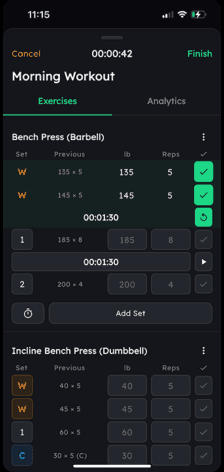
This is the magic of being a beginner. Your only goal is to add a small amount of weight to the bar every single workout. For most people, this means adding 5 pounds (2.5 lbs per side) to your squat and bench press each session.
Example Beginner Routine (StrongLifts 5x5 or similar):
Workout A:
- Squat: 3 sets of 5 reps
- Bench Press: 3 sets of 5 reps
- Barbell Row: 3 sets of 5 reps
Workout B:
- Squat: 3 sets of 5 reps
- Overhead Press: 3 sets of 5 reps
- Deadlift: 1 set of 5 reps
You simply alternate between Workout A and Workout B, with a rest day in between. Every time you repeat a lift, you add 5 pounds. You do this until you physically cannot complete your sets for 2-3 workouts in a row. That's when you know it's time to change something.
When and How to Switch to an Advanced Structure
You don't switch to an advanced routine because you've been in the gym for a year. You switch when your body forces you to. The signal is simple and unavoidable: a hard plateau.
A plateau is not one bad day. It's when you fail to hit your target reps and add weight on a specific lift for two or three consecutive weeks, even with good sleep and nutrition. For example, if you've been stuck at a 185 lb bench press for 3 weeks, you've hit a plateau.
This happens because you've exhausted your ability to recover and adapt from a full-body stimulus. The weight is now heavy enough that a 3x5 squat session on Monday leaves your legs too fatigued to perform well again on Wednesday. The beginner model breaks down.
At this point, you need two things:
- More Volume: To continue getting stronger, each muscle now needs more total sets per week (moving from 9-12 to 15-20).
- More Recovery Time: You can't cram that much volume into a full-body workout and recover in 48 hours.
The solution is to switch to a 'split' routine. By splitting your body into different days, you can hammer one or two muscle groups with the high volume they need, and then give them a full week to recover before hitting them again.
This is the transition from a beginner to an intermediate/advanced lifter. You stop prioritizing frequency and start prioritizing volume.
Weeks of progress. All in one place.
Every workout logged. Proof you are getting stronger.
Available on iOS and Android
Advanced Workout Structure: Volume, Splits, and Periodization
This structure is for lifters who have been training consistently for over a year and whose progress is measured in months, not weeks. You've already built a solid strength base, and now you're chiseling the statue.
Frequency and Splits: 4-6 Days Per Week
Advanced lifters train more often, but they train each muscle group less frequently than a beginner does on a full-body routine. The goal is to hit each muscle group hard twice per week.
Common effective splits include:
- Upper/Lower Split (4 days/week): You have an upper body day and a lower body day, which you perform twice a week. (e.g., Mon: Upper, Tue: Lower, Thu: Upper, Fri: Lower).
- Push/Pull/Legs (PPL) Split (6 days/week): You have a push day (chest, shoulders, triceps), a pull day (back, biceps), and a leg day (quads, hamstrings, calves). You run through this cycle twice a week.
Volume: The Primary Driver of Growth
For an advanced lifter, volume is king. The goal is to accumulate 15-20 hard sets per muscle group per week. This is why splits are necessary. You can't possibly do 15 sets for your chest in a full-body workout without compromising every other exercise.
An advanced upper body day might look like this:
- Bench Press: 4 sets of 5-8 reps
- Incline Dumbbell Press: 3 sets of 8-12 reps
- Weighted Pull-ups: 4 sets of 6-10 reps
- Seated Cable Row: 3 sets of 10-15 reps
- Lateral Raises: 4 sets of 12-20 reps
This workout alone has 11 sets for your chest and back, already exceeding a beginner's entire weekly volume for those muscles.
Progression: Periodization
Advanced lifters cannot add 5 pounds every week. Instead, they use periodization-planning their training in cycles. They might spend 4 weeks focused on accumulating volume with lighter weight and higher reps (an 'accumulation' block), followed by 4 weeks focused on increasing intensity with heavier weight and lower reps (an 'intensification' block).
Progress isn't linear. It's cyclical. They might aim to add 5 pounds to their best set of 5 reps every 4-8 weeks, not every 48 hours.
Frequently Asked Questions
How do I know if I'm a beginner or advanced?
It's not about time; it's about progress. If you can add 5 pounds to your squat or bench press every week, you are a beginner and should use a beginner structure. If you can't, and progress is measured over months, you need an advanced structure.
Are there 'advanced' exercises I should be doing?
No. Advanced lifters build their workouts around the same compound lifts: squats, deadlifts, bench presses, and rows. They simply add more isolation exercises (like bicep curls or leg extensions) to increase total volume for a specific muscle and bring up weak points.
What rep range is best for beginners vs. advanced?
Beginners should stick to the 5-8 rep range on compound lifts to build a strong foundation and practice good form. Advanced lifters use multiple rep ranges: heavy sets of 3-5 reps for strength, moderate sets of 8-12 for hypertrophy, and high-rep sets of 15-20 for metabolic stress.
How long should I rest between sets?
This is the same for both levels. For heavy, multi-joint compound lifts like squats and deadlifts, rest 3-5 minutes to ensure full strength recovery. For smaller isolation exercises like dumbbell curls or tricep pushdowns, 60-90 seconds is sufficient.
Conclusion
Your workout structure must match your body's ability to adapt. Stop looking for magic exercises and start being honest about your rate of progress.
If you can get stronger every week, stick with a simple 3-day full-body routine. When that stops working, and only then, earn your right to move to a higher-volume split routine. Use the right tool for the job.
All content and media on Mofilo is created and published for informational purposes only. It is not intended to be a substitute for professional medical advice, diagnosis, or treatment. Always seek the advice of your physician or other qualified health provider with any questions you may have regarding a medical condition, including but not limited to eating disorders, nutritional deficiencies, injuries, or any other health concerns. If you think you may have a medical emergency or are experiencing symptoms of any health condition, call your doctor or emergency services immediately.