30 Minute Strength Training 3 Times a Week Enough

We hope you enjoy reading this blog post. Ready to upgrade your body? Try Mofilo Free
By Mofilo Team
Published
You're crunched for time, but you want to see real change. You've heard you need to be in the gym for hours, and you're wondering if your limited schedule is even worth the effort. Let's clear this up right now.
Key Takeaways
- Yes, 30 minutes of strength training 3 times a week is enough to build muscle and strength, especially if you are a beginner or intermediate.
- The effectiveness of a 30-minute workout depends entirely on intensity; you must use compound exercises and keep rest periods to 60 seconds or less.
- A 3-day full-body routine is the most efficient structure, as it stimulates each muscle group multiple times per week, maximizing growth signals.
- You must apply progressive overload. This means adding a small amount of weight (like 5 pounds) or one extra rep to your lifts each week to force your muscles to adapt.
- Without proper nutrition, your workouts won't produce visible results. Aim for 0.8-1.0 grams of protein per pound of bodyweight daily.
- Realistically, you can expect to gain 5-10 pounds of muscle in your first year on this plan if your diet and consistency are perfect.
Is 90 Minutes a Week Really Enough?
To make 30 minute strength training 3 times a week enough, you must prioritize intensity and efficiency over duration-it's not about the clock, it's about the work. You've been led to believe that a workout isn't effective unless it's 60-90 minutes long, 5 days a week. That's the ideal scenario for a competitive athlete, not a busy person trying to get stronger and look better.
Let's be honest. The person in the gym for 90 minutes is probably only doing about 25-30 minutes of actual, focused work. The rest is scrolling on their phone, chatting, and taking 5-minute rest periods. Your focused 30 minutes, done right, can be more productive than their entire session.
Think of it as total weekly volume. A total of 90 minutes of high-intensity, structured training is infinitely better than zero minutes. It's more than enough to trigger the biological responses for muscle growth and strength adaptation.
This approach is for you if you're a beginner, someone getting back into fitness after a break, or a busy professional or parent who values efficiency. It provides the minimum effective dose to see real progress.
This is not for you if you're an advanced bodybuilder or powerlifter trying to maximize your genetic potential. At that level, more volume and frequency are required. But for 95% of people, this is a powerful and sustainable starting point.

See your strength actually grow.
Track your lifts. Watch yourself get stronger week by week.
No commitment · Cancel anytime
Why Most 30-Minute Workouts Fail
If you've tried 30-minute workouts before and saw no results, it wasn't because the time was too short. It's because the workout itself was wrong. Most short workouts fail for four specific reasons.
First, they lack structure. Following a random YouTube video or just doing whatever machines are open leads nowhere. Muscle growth requires a consistent, repeatable plan that allows you to track progress. Without a plan, you can't apply progressive overload, which is the single most important principle of strength training.
Second, they focus on the wrong exercises. Isolation movements like bicep curls, tricep extensions, and leg raises are a poor use of limited time. They only work one small muscle at a time. You get far more bang for your buck from compound exercises that work multiple muscle groups simultaneously.
Third, the intensity is too low. A 30-minute workout must feel hard. That means short rest periods of 45-60 seconds. If you have enough breath to hold a full conversation between sets, you're not working hard enough. The goal is to create metabolic stress and muscular fatigue, which signals your body to build back stronger.
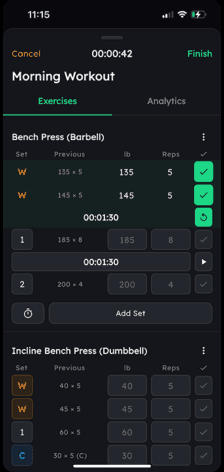
Finally, people don't track anything. If you are lifting the same weights for the same reps and sets as you did three months ago, your body has no reason to change. You must keep a log of your workouts. It takes 30 seconds and is the only way to ensure you are consistently doing more work over time.
The 30-Minute, 3-Day Full-Body Plan That Works
For a 3-day-a-week schedule, a full-body routine is non-negotiable. It allows you to hit every major muscle group three times per week, which is optimal for triggering muscle growth. A body-part split (like a "chest day") only works each muscle once a week, which isn't enough frequency for this schedule.
The plan is simple. Each workout has 3-4 compound exercises. You will perform 3 working sets for each. Your goal is to complete the entire workout in under 30 minutes. This means you must be disciplined with your rest periods: no more than 60 seconds between sets.
Workout A (e.g., Monday)
- Goblet Squats: 3 sets of 8-12 reps. (Works quads, glutes, core)
- Push-Ups or Dumbbell Bench Press: 3 sets of 8-12 reps. (Works chest, shoulders, triceps)
- Dumbbell Rows: 3 sets of 10-15 reps per arm. (Works back, biceps)
- Plank: 3 sets, hold for 30-60 seconds.
Workout B (e.g., Wednesday)
- Dumbbell Romanian Deadlifts (RDLs): 3 sets of 10-15 reps. (Works hamstrings, glutes, lower back)
- Dumbbell Overhead Press: 3 sets of 8-12 reps. (Works shoulders, triceps)
- Pull-Ups (or Banded/Assisted): 3 sets to failure. If you can't do pull-ups, do Lat Pulldowns or Dumbbell Pullovers. (Works back, biceps)
- Reverse Crunches: 3 sets of 15-20 reps.
Workout C (e.g., Friday)
- Walking Lunges: 3 sets of 10-12 reps per leg. (Works quads, glutes)
- Incline Dumbbell Press: 3 sets of 8-12 reps. (Works upper chest, shoulders)
- Face Pulls or Band Pull-Aparts: 3 sets of 15-20 reps. (Works rear delts, upper back, posture)
- Farmer's Walk: 3 sets, walk 30-40 yards. (Works grip, core, traps)
The Golden Rule: Progressive Overload
This plan only works if you do more over time. Each week, your goal is to beat your previous performance. For example, if you did Goblet Squats with a 40 lb dumbbell for 10, 9, and 8 reps in Week 1, your goal for Week 2 is to get 10, 10, 9 reps. Once you can hit 12 reps on all three sets, increase the weight to 45 lbs and start back at 8 reps. This is how you force progress.
Weeks of progress. All in one place.
Every workout logged. Proof you're getting stronger.
No commitment · Cancel anytime
What Results to Realistically Expect
This is not a magic 12-week transformation that will make you look like a cover model. This is a realistic, sustainable plan for building a strong, athletic body over time. Honesty is crucial, so here is what the timeline actually looks like.
In the First 4-6 Weeks: You will feel the biggest changes. You'll get significantly stronger as your nervous system becomes more efficient at recruiting muscle fibers. This is called "newbie gains." You might gain 2-4 pounds on the scale from increased muscle glycogen and water, making your muscles look fuller. Visible muscle growth will be minimal, but your clothes might start to fit a little differently.
In Months 2-6: This is where the visible progress begins, provided your nutrition is on point. You will start to see more shape and definition in your shoulders, back, and legs. You can expect to add 20-30 pounds to your main lifts. If you are eating in a slight calorie surplus with enough protein, gaining 4-8 pounds of actual muscle tissue in this period is a realistic goal for a beginner.
In Months 6-12: Progress will slow down. This is normal and expected. You are no longer a beginner. Gains will be harder to come by, but they are still happening. You might add another 3-5 pounds of muscle in this timeframe. The biggest win here is the habit. You will have successfully integrated an effective training plan into your life for a full year, creating a foundation for lifelong fitness.
Remember, these results are entirely dependent on two things outside the gym: getting 7-8 hours of sleep per night and eating enough protein (0.8-1.0 grams per pound of your bodyweight). Without those, you are just spinning your wheels.
Frequently Asked Questions
Can I lose fat with this routine?
Yes, you can absolutely lose fat with this routine, but fat loss is dictated by your diet, not your workout. To lose fat, you must be in a calorie deficit. This strength training plan ensures that the weight you lose is primarily fat, not precious muscle.
Should I do cardio on my off days?
If your goal is fat loss or heart health, adding 20-30 minutes of low-intensity cardio, like a brisk walk or light cycling, on your off days is a great idea. Avoid high-intensity interval training (HIIT), as it can interfere with your recovery from strength workouts.
What if I can only work out 2 times a week?
Two times a week is still effective, but you must use a full-body routine on both days. You won't progress as quickly as with three days, but it is far better than doing nothing. Consistency is what matters most.
Is this enough for an advanced lifter?
No. An advanced lifter (someone with 3+ years of consistent, structured training) needs more volume and intensity to continue making progress. This routine is designed for beginners and intermediates who are still sensitive to lower training volumes.
What equipment do I need for this plan?
This plan is designed to be done with minimal equipment. All you truly need is a set of adjustable dumbbells that go up to at least 50 pounds, a pull-up bar, and maybe some resistance bands. This can easily be done in a basic apartment gym or at home.
All content and media on Mofilo is created and published for informational purposes only. It is not intended to be a substitute for professional medical advice, diagnosis, or treatment. Always seek the advice of your physician or other qualified health provider with any questions you may have regarding a medical condition, including but not limited to eating disorders, nutritional deficiencies, injuries, or any other health concerns. If you think you may have a medical emergency or are experiencing symptoms of any health condition, call your doctor or emergency services immediately.